Mastering the 5v5 Full Court Press Break
Equip your team with a reliable, structured system to safely advance the ball against aggressive full-court pressure and convert defensive over-commitments into high-percentage scoring opportunities.
Equipment Needed
1. Overview
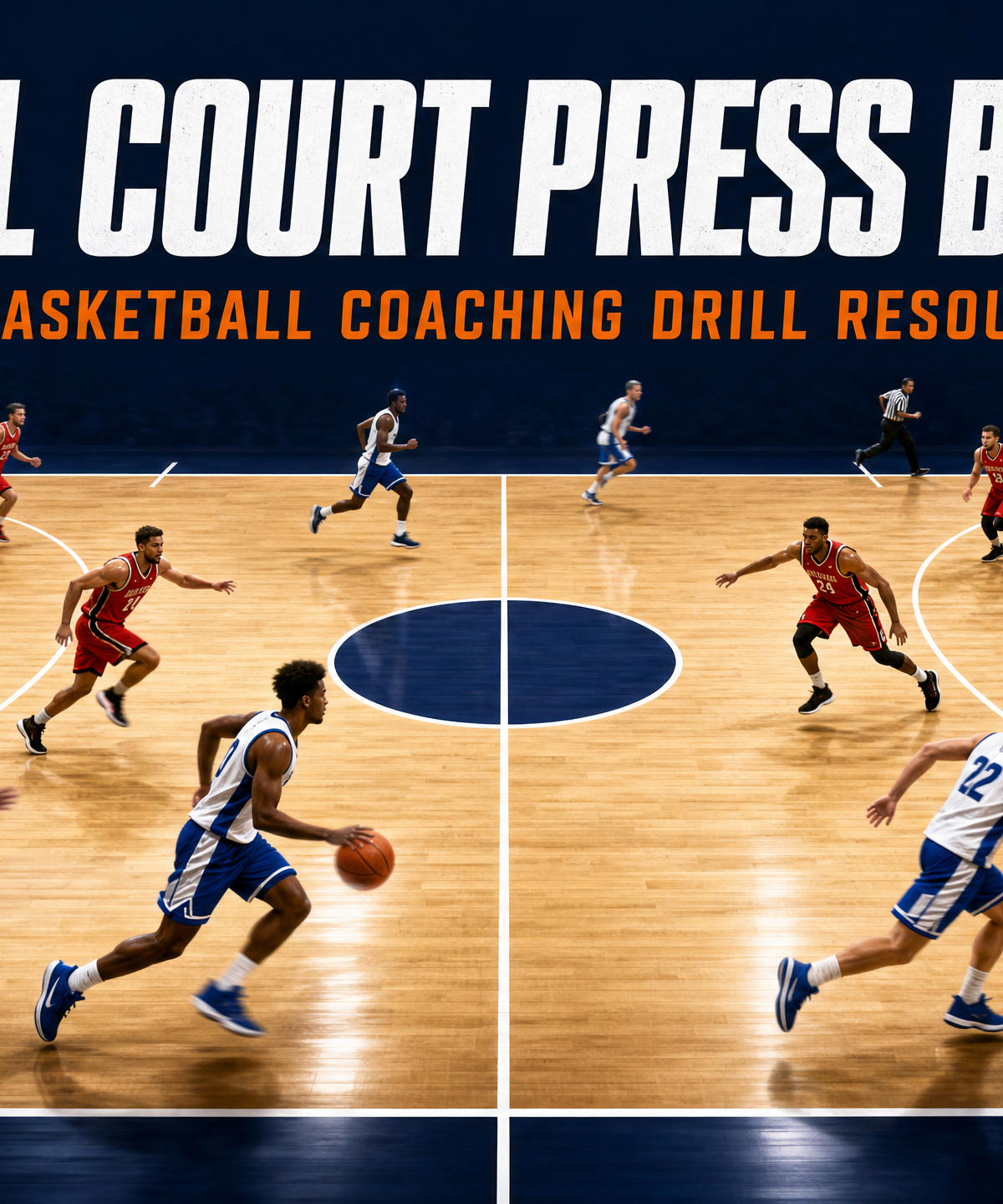
Facing a well-executed full-court press can rattle even experienced teams, leading to rushed decisions, costly turnovers, and rapid momentum shifts. The 5v5 Full Court Press Break Drill is designed to instill composure, structured spacing, and decisive ball movement in your players. Rather than merely surviving the press, this drill teaches teams to exploit the defensive over-extension and attack the basket with numerical advantages.
This resource provides a comprehensive framework for breaking a standard 2-2-1 or 1-2-1-1 full-court press, emphasizing spacing, meeting passes, and looking up the floor.
2. Setup
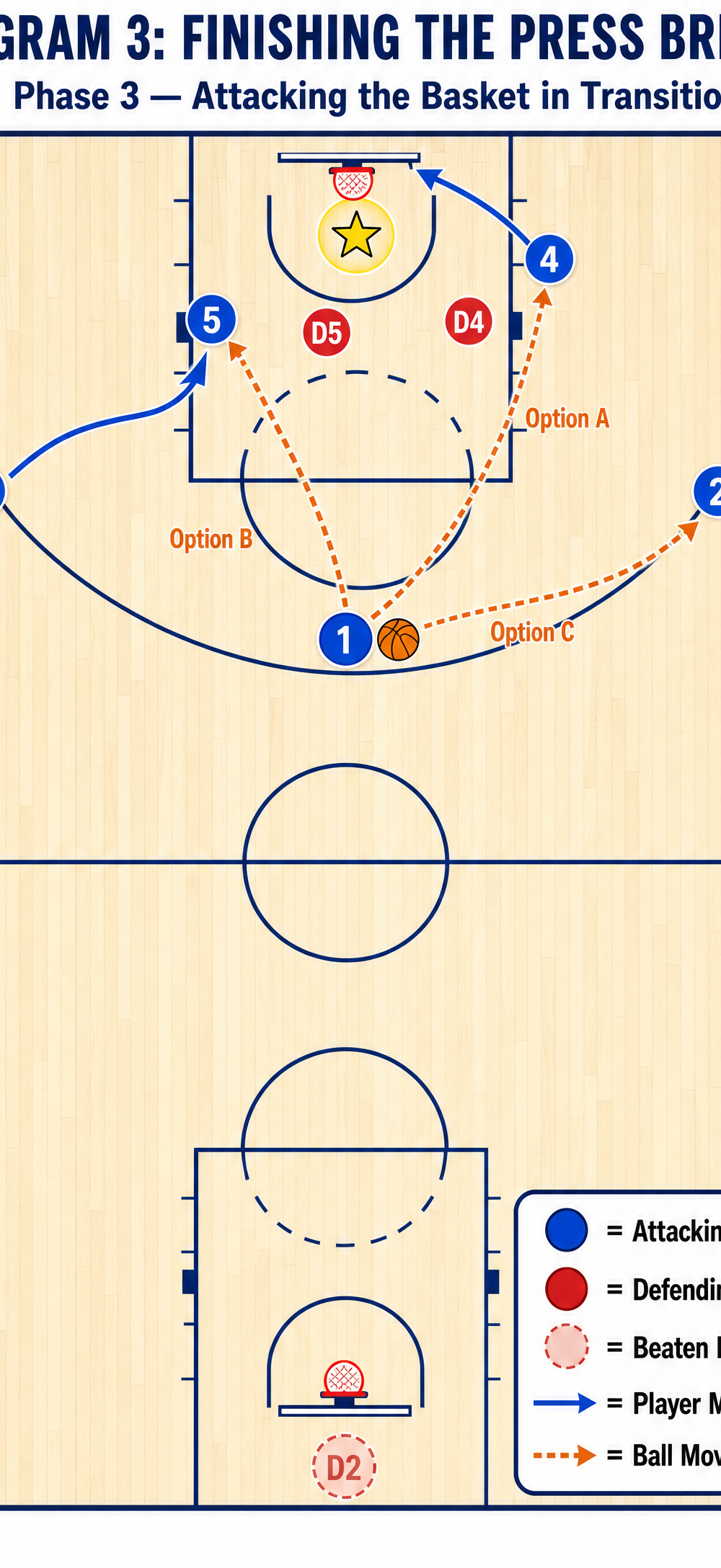
- Court Dimensions: Standard FIBA full court (28m x 15m).
- Players: 10 players minimum (5 offensive, 5 defensive).
- Equipment: 1 basketball, colored practice pinnies to distinguish teams.
- Starting Positions:
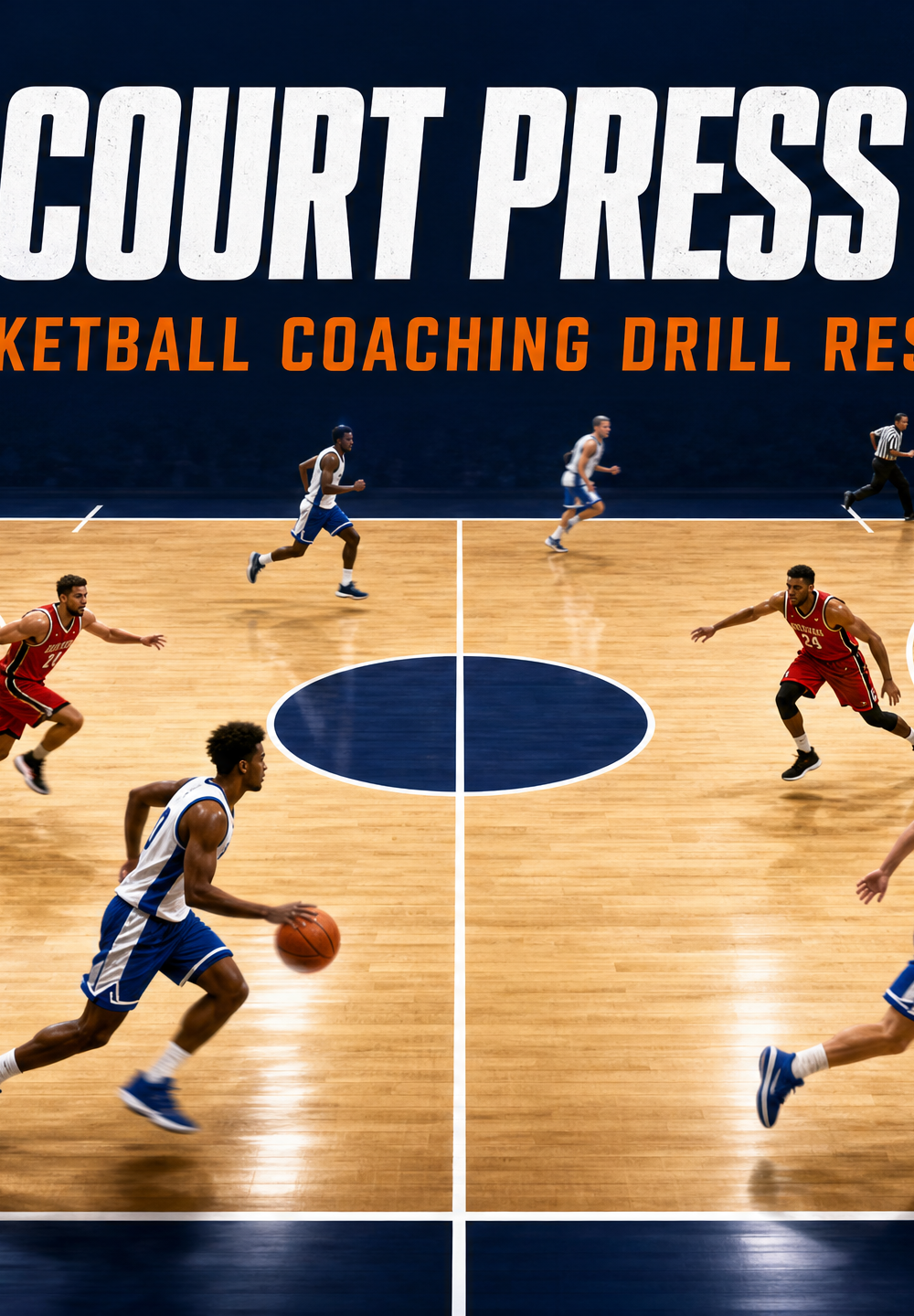
- Offense (Blue): Player 1 (Point Guard) takes the ball out of bounds on the baseline. Players 2 and 3 start at the free-throw line extended on opposite sidelines. Players 4 and 5 position themselves at the half-court line.
- Defense (Red): Set up in a 2-2-1 full-court press formation. Two defenders pressure the inbound, two sit at the free-throw line extended, and one acts as the safety at half-court.
3. Step-by-Step Instructions
Phase 1: The Inbound and Initial Release
- The Setup: The drill begins with Player 1 (PG) holding the ball out of bounds on the baseline. The referee (coach) hands the ball to Player 1 to initiate the 5-second count.
- The V-Cut: Players 2 and 3 must execute sharp V-cuts. They walk their defender up the sideline, plant their outside foot, and sprint back toward the baseline to create a passing lane.
- The Inbound Pass: Player 1 reads the defense and makes a crisp, two-handed chest or bounce pass to either Player 2 or Player 3. The receiver must step toward the pass to prevent defensive deflections.
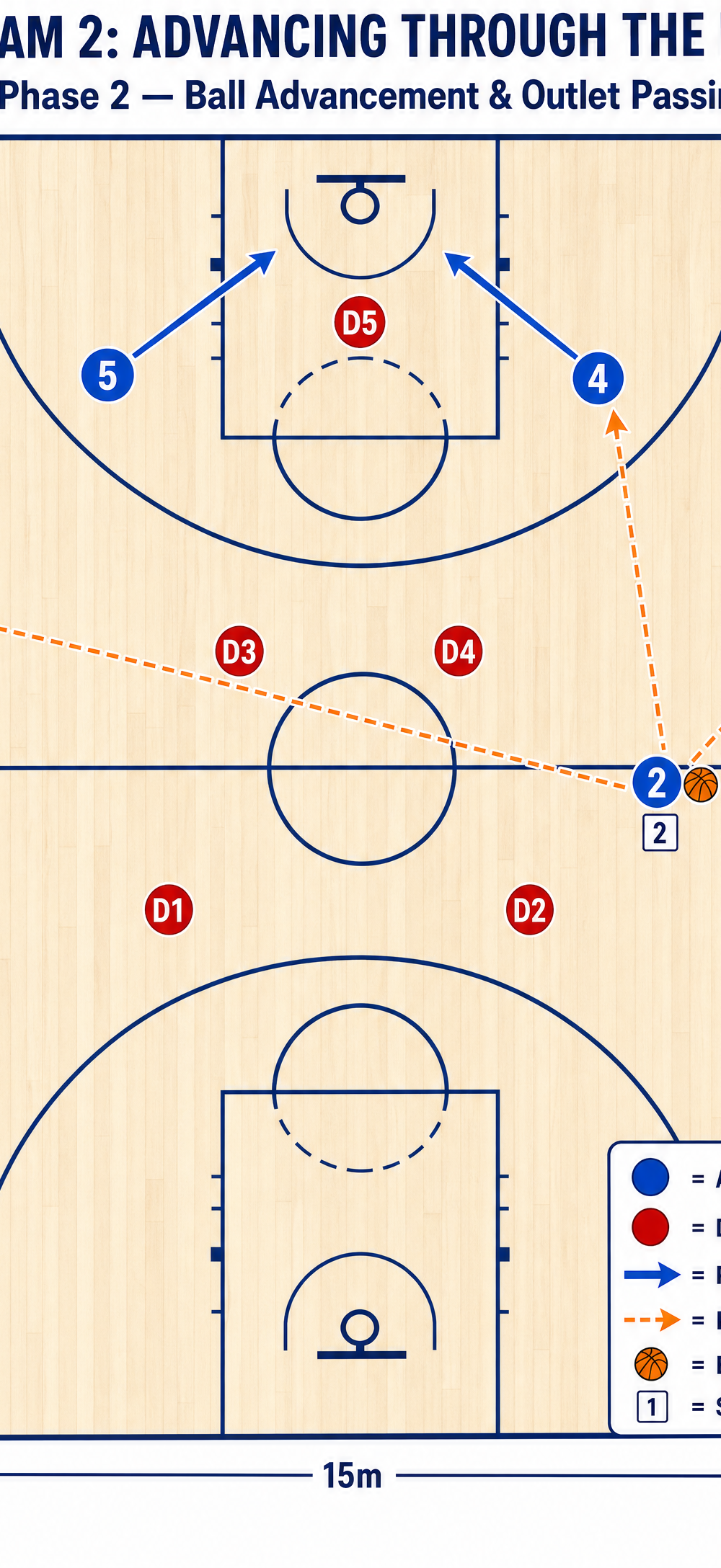
Phase 2: Advancing Through the Press
- Middle Support: As soon as the inbound pass is caught (e.g., by Player 2), Player 1 immediately steps inbounds and sprints up the sideline to stay behind the ball as a safety valve.
- Flash to the Middle: Player 4 or Player 5 flashes from half-court into the middle of the floor (around the top of the key in the backcourt) to provide a central target.
- Look Up the Floor: Player 2 pivots to face the opposite basket. The primary look is up the sideline to Player 3 (who has sprinted up the weak side) or ahead to the flashing big man in the middle.
- The Outlet Pass: Player 2 delivers an overhead or strong chest pass to the open teammate, bypassing the initial layer of the press.
Phase 3: Attacking the Basket
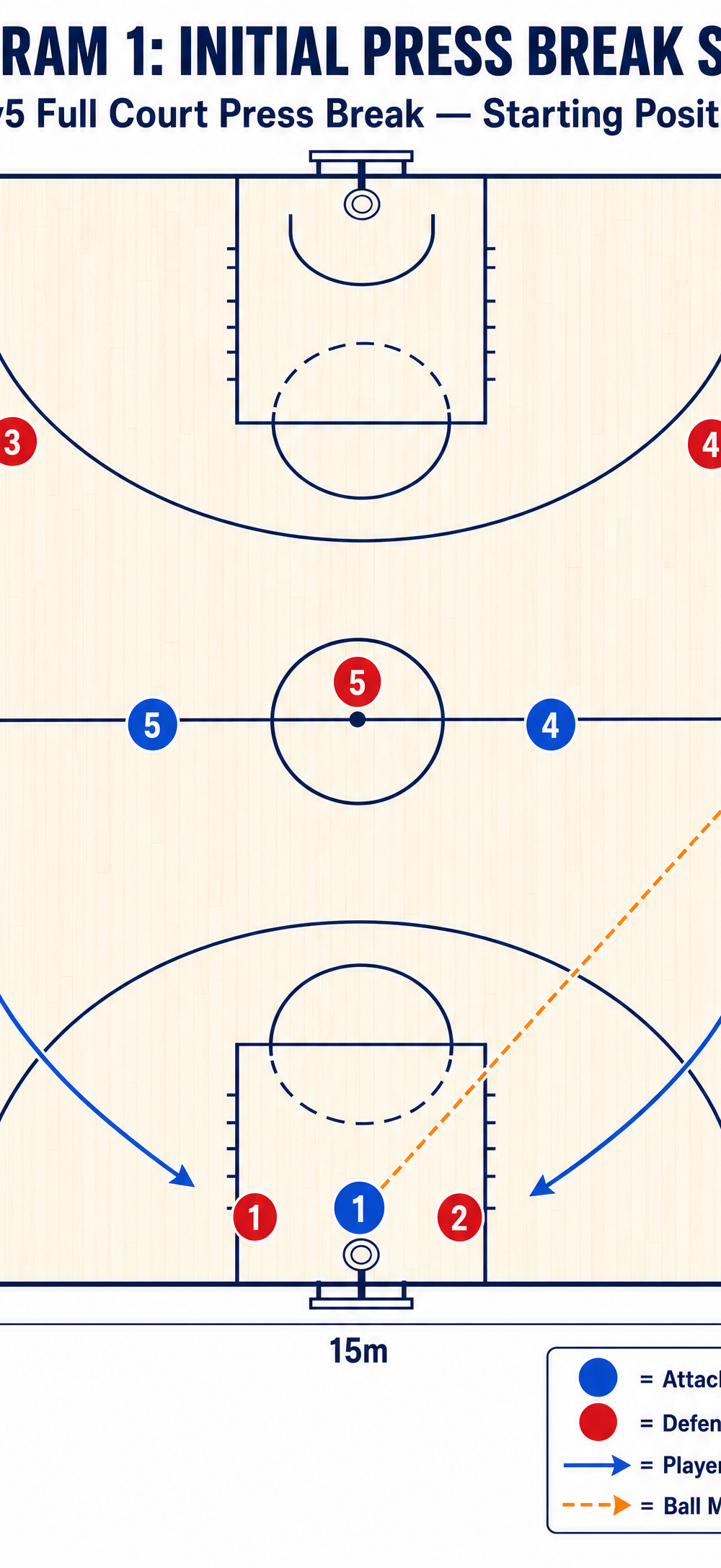
- Numerical Advantage: Once the ball crosses half-court, the offense should have a 3-on-2 or 2-on-1 advantage.
- Maintain Spacing: The ball handler (now Player 1 or Player 3) attacks the top of the key. Wing players run wide to the three-point line, and the trailing big man cuts hard to the rim.
- The Finish: The ball handler reads the remaining defenders and makes the final decision: a lob to the cutting big man, a kick-out to the wing for a shot, or taking it to the rim for a layup.
4. Key Coaching Points
- Meet the Pass: Receivers must aggressively step toward the ball on every pass. Waiting for the ball allows recovering defenders to intercept.
- Stay Off the Sidelines: Encourage players to catch the ball in the middle third of the floor whenever possible. The sideline acts as an extra defender, making traps highly effective.
- Look Before You Dribble: The first instinct upon catching the ball should be to pivot and face the opposite basket. Passing beats the press faster than dribbling.
- Fake a Pass to Make a Pass: Use ball fakes to shift the defense and open up passing lanes, especially against active zone presses.
- Maintain Composure: Emphasize calm decision-making. Panic leads to high, looping passes that are easily intercepted.
5. Common Mistakes
- Hiding Behind Defenders: Offensive players standing stationary behind their defender instead of cutting to open space.
- Over-Dribbling: Attempting to beat a double-team with the dribble rather than passing out of the trap quickly.
- Throwing 'Hope' Passes: Lobbing soft, looping passes over the defense, giving athletic defenders time to recover and intercept.
- Forgetting the Safety: The inbounder failing to step inbounds and trail the play, leaving the ball handler without a pressure-release option.
6. Variations & Progressions
- Progression 1 (No Dribble): Run the drill with a strict 'no dribble' rule. This forces players to rely entirely on spacing, cutting, and crisp passing to break the press.
- Progression 2 (Advantage/Disadvantage): Start the drill with 5 offensive players against 6 defenders to simulate intense, chaotic pressure and force quicker decision-making.
- Variation 1 (Different Press Formations): Switch the defensive formation to a 1-2-1-1 diamond press or a man-to-man run-and-jump press to test the offense's adaptability.
7. Age Adaptations
- Under 10 / Under 12: Focus purely on the fundamentals of the inbound pass and the immediate outlet. Reduce defensive pressure to 50% to build confidence. Emphasize pivoting and not panicking.
- Under 14 / Under 16: Introduce the 'no dribble' progression to reinforce passing mechanics. Teach players how to read the secondary line of the press and make skip passes.
- Open / Advanced: Run the drill at full game speed with aggressive trapping. Incorporate complex secondary breaks and transition offense sets once the ball crosses half-court.