Horns Set Play: The Three-Point Attack
Master the classic Horns offensive set to create wide-open three-point opportunities and exploit defensive mismatches.
Equipment Needed
Overview
The Horns set is one of the most versatile and widely used offensive alignments in modern basketball. Originating from the classic 1-4 high alignment, it positions two bigs at the elbows and two shooters in the corners, leaving the paint completely open. This specific variation focuses on generating high-quality three-point shots by forcing the defense to make difficult rotation decisions. It is particularly effective against man-to-man defenses and teams that aggressively hedge on ball screens.
Setup
To run this play effectively, you need a standard 28m x 15m FIBA court with a clear three-point arc.
Player Positions:
- 1 (Point Guard): Starts at the top of the key with the ball.
- 2 (Shooting Guard): Starts at the right elbow.
- 3 (Small Forward): Starts in the deep left corner.
- 4 (Power Forward): Starts at the left elbow.
- 5 (Center): Starts in the deep right corner.
Step-by-Step Instructions
Phase 1: The Entry and Screen
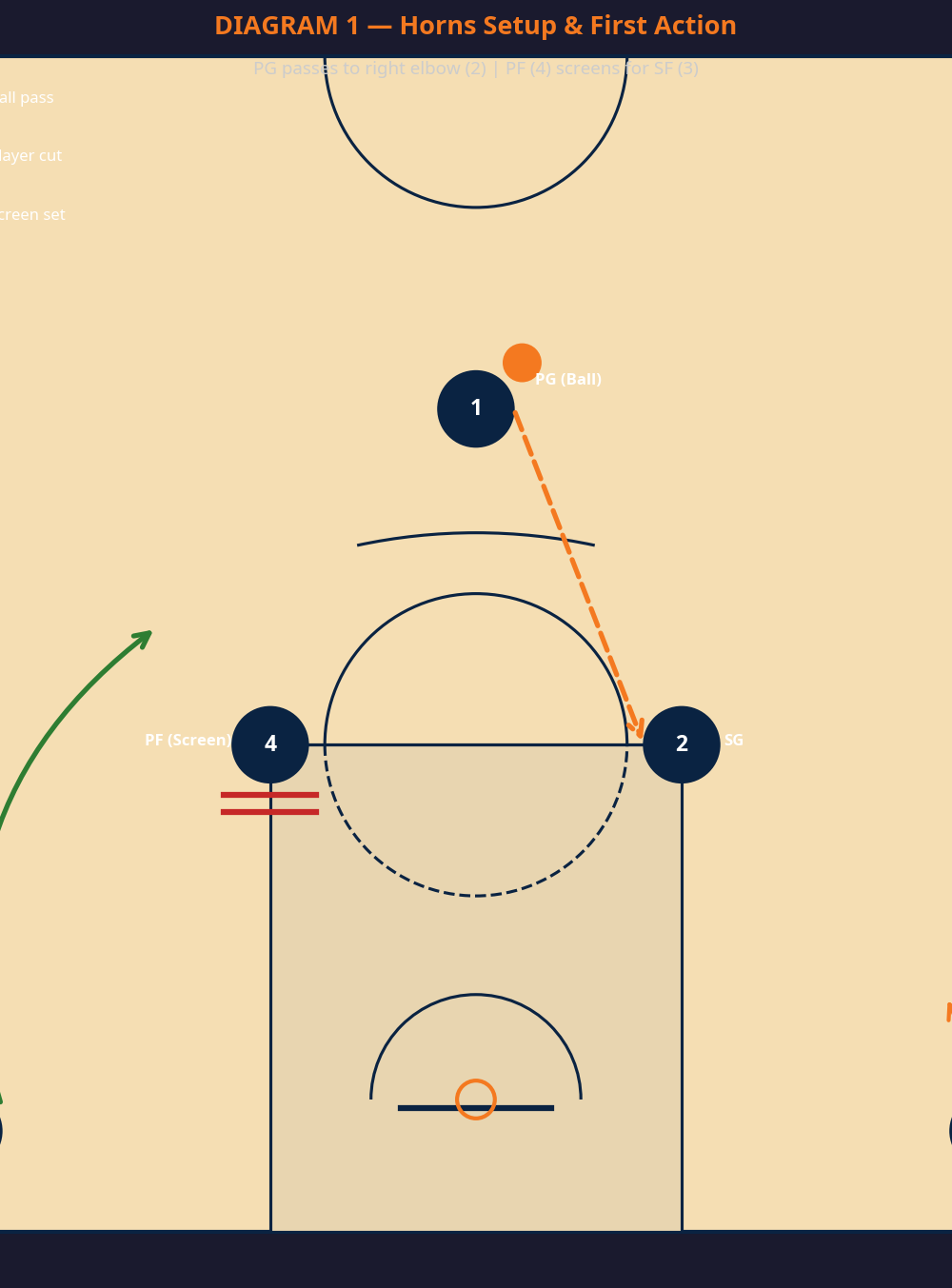
- The Entry Pass: The Point Guard (1) dribbles down the middle of the floor and initiates the offense by passing to the Shooting Guard (2) at the right elbow.
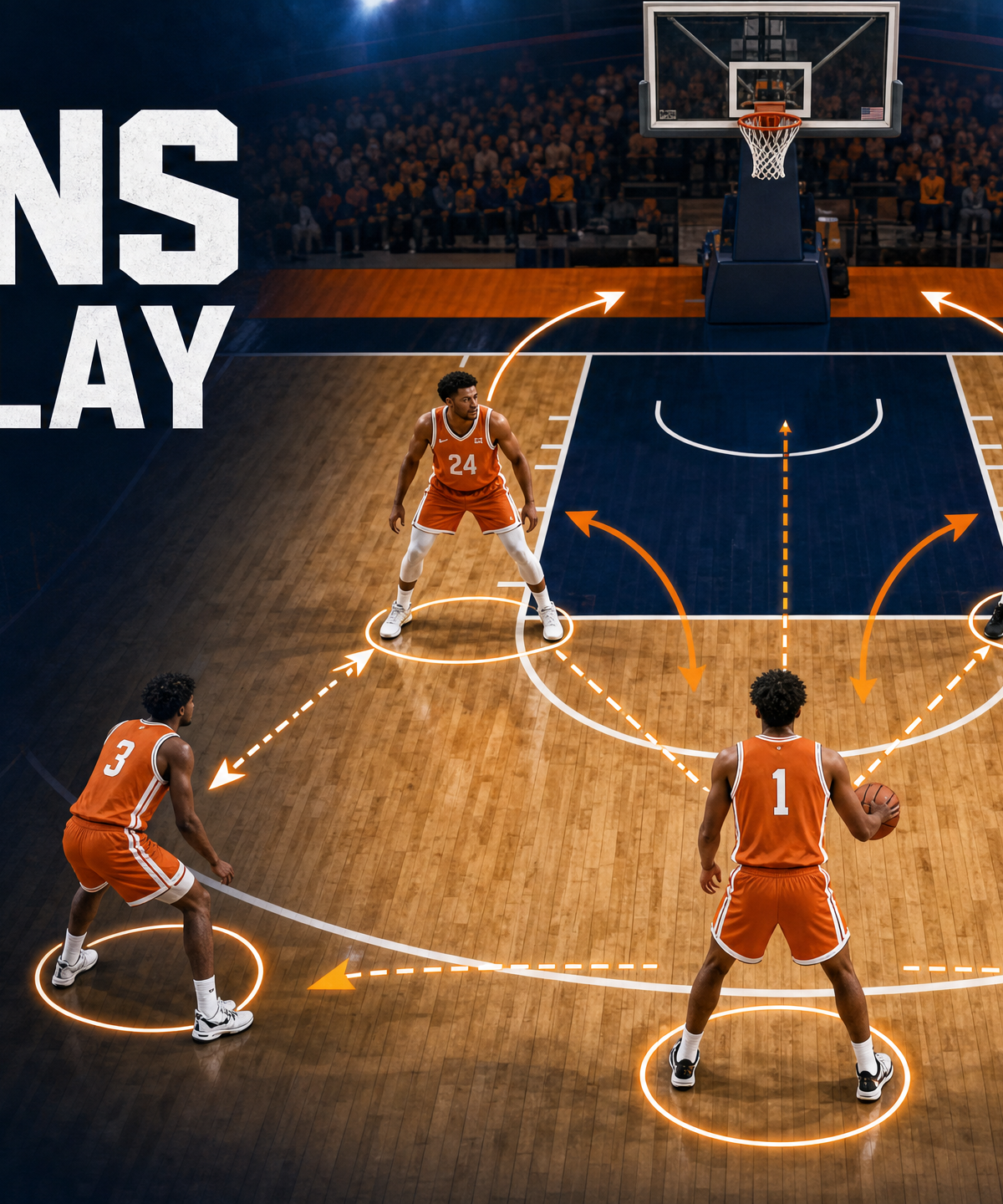
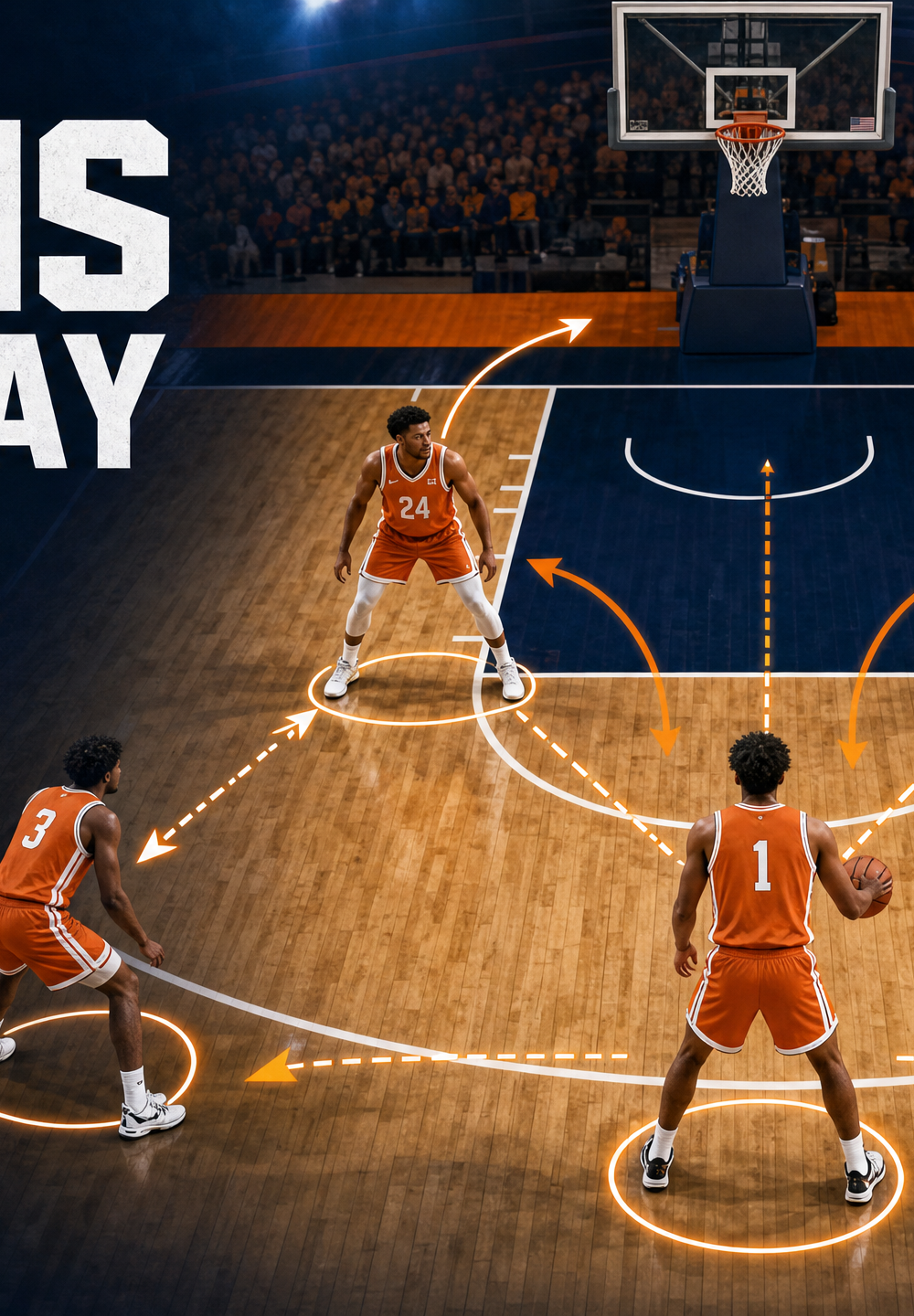
- The Weak-Side Action: As soon as the pass is made, the Power Forward (4) at the left elbow turns and sets a hard down-screen for the Small Forward (3) in the left corner.
- The Cut: The Small Forward (3) uses the screen to cut sharply to the left wing (three-point line area).
- Spacing: Simultaneously, the Center (5) in the right corner slides slightly higher up the sideline to maintain spacing and prepare for a potential kick-out.
Phase 2: Reading the Defense
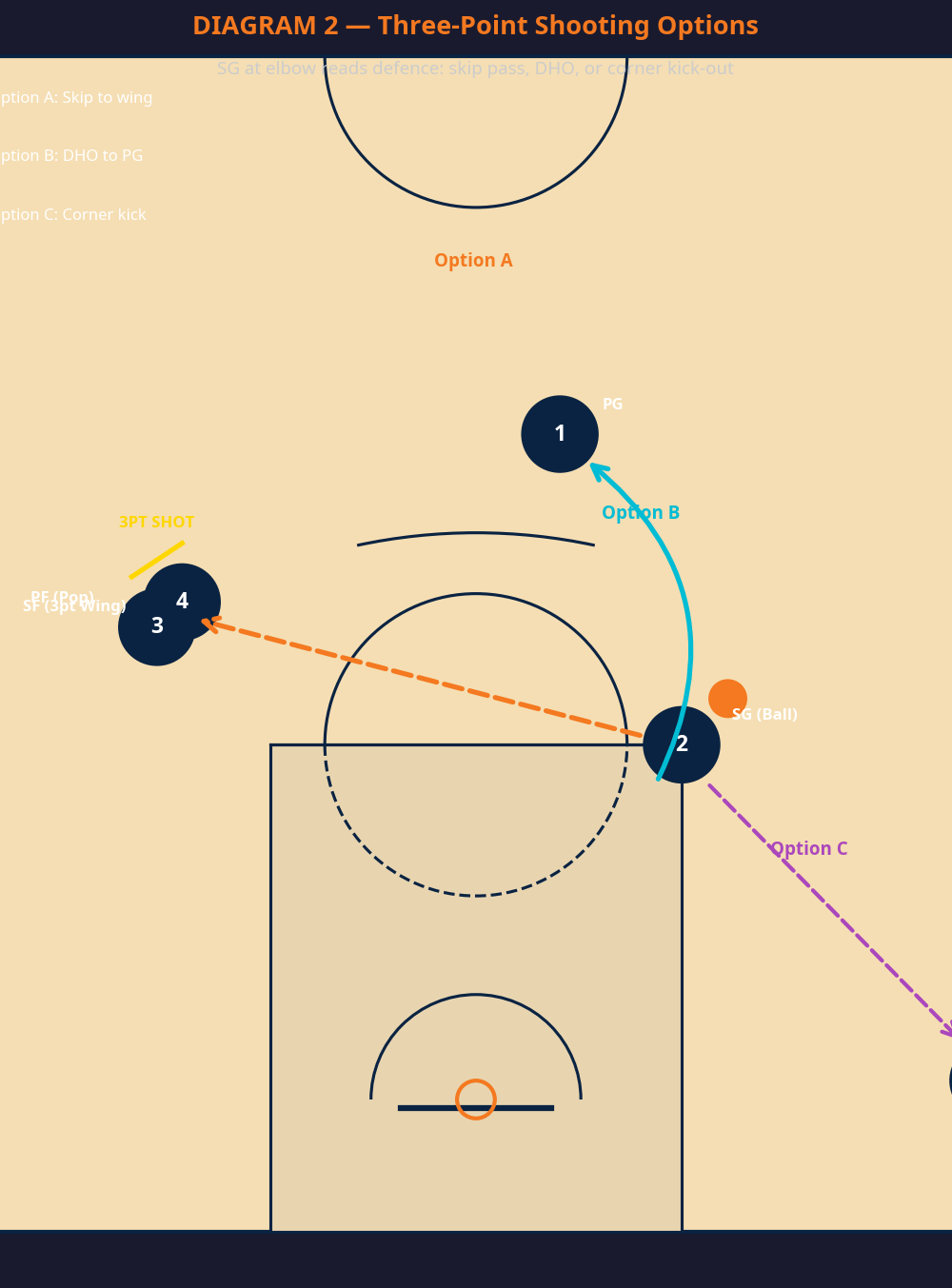
With the ball in the hands of the Shooting Guard (2) at the elbow, they now become the primary playmaker and must read the defense to choose the best scoring option.
Option A: The Skip Pass (Primary Target)
If the defender guarding the Small Forward (3) gets caught on the screen set by the Power Forward (4), the Shooting Guard (2) immediately fires a skip pass across the court to the wide-open Small Forward (3) for a catch-and-shoot three-pointer.
Option B: Dribble Hand-Off (DHO)
If the skip pass is covered, the Point Guard (1) relocates towards the ball. The Shooting Guard (2) executes a dribble hand-off (DHO) with the Point Guard (1). The Point Guard can then turn the corner to attack the rim, pull up for a shot, or draw a defender and kick out.
Option C: The Corner Kick
If the defense collapses on the elbow action or the DHO, the Center (5) in the right corner is often left unattended. The Shooting Guard (2) or Point Guard (1) can kick the ball out to the corner for an open three.
Phase 3: The Flare Screen Variation
To keep the defense guessing, you can run a variation that targets the opposite corner.
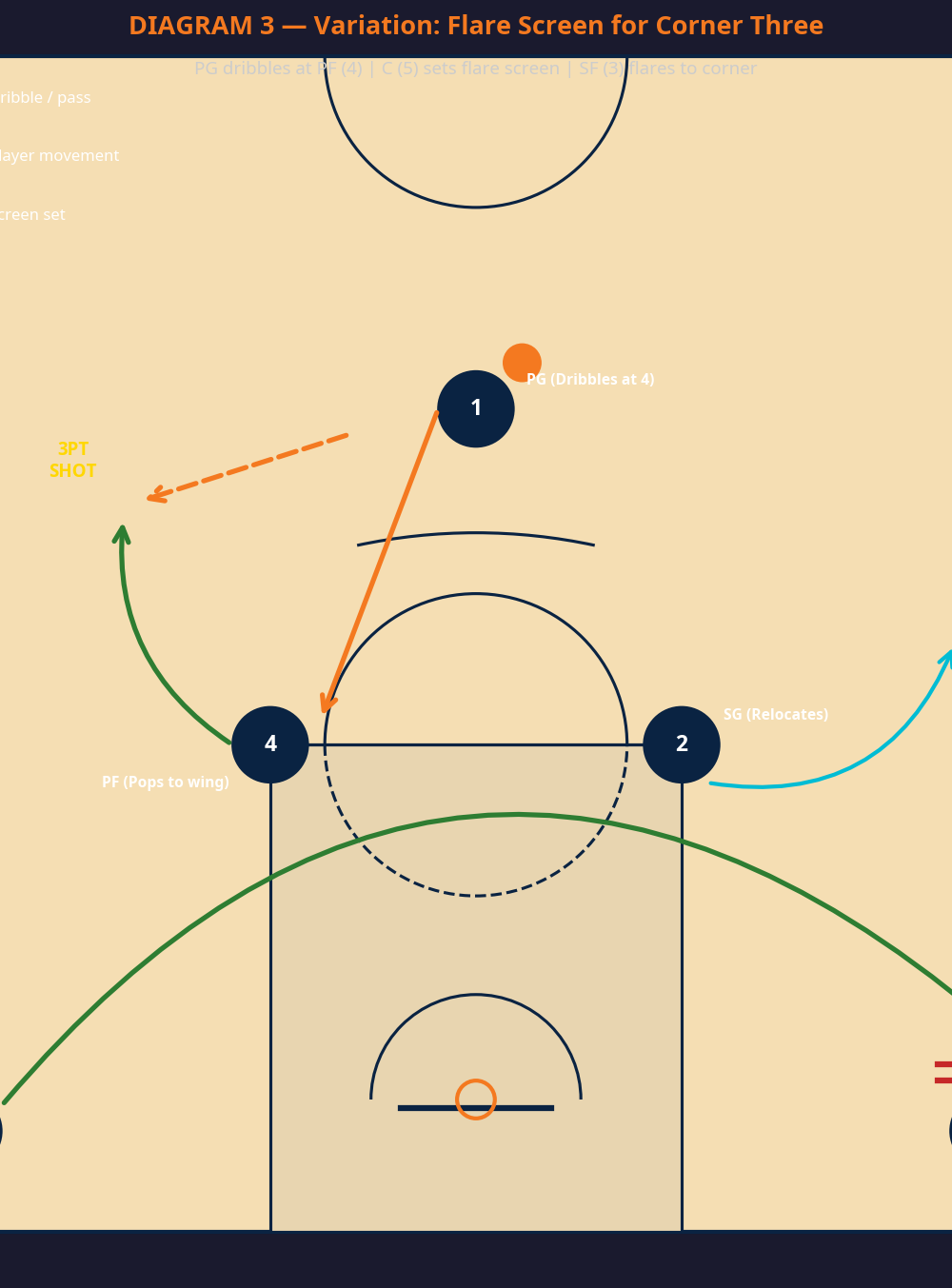
- The Dribble Entry: Instead of passing, the Point Guard (1) dribbles aggressively towards the Power Forward (4) at the left elbow.
- The Pop and Flare: The Power Forward (4) pops out to the left wing. Simultaneously, the Center (5) sets a blind flare screen for the Small Forward (3).
- The Corner Flare: The Small Forward (3) uses the flare screen to sprint along the baseline to the right corner.
- The Delivery: The Point Guard (1) pitches the ball to the Power Forward (4), who immediately swings it to the Small Forward (3) arriving in the right corner for the shot.
Key Coaching Points
- Screening Angles: The screens set by the 4 and 5 must be solid and set at the correct angle to completely seal off the defender. "Head on a swivel" is crucial for the screener.
- Patience at the Elbow: The player catching the ball at the elbow (2) must not rush. They need to pivot, face the basket, and actively read the defense before committing to a pass or DHO.
- Cutting Speed: The cutters (3) must change pace. They should walk their defender down slowly, then explode off the screen shoulder-to-shoulder with the screener.
- Pass Accuracy: Skip passes must be thrown with velocity and accuracy, ideally hitting the shooter right in their shooting pocket.
Common Mistakes
- Slipping the Screen: Cutters failing to wait for the screen to be fully set, resulting in an offensive foul or an ineffective screen.
- Poor Spacing: Players creeping inside the three-point line, which clogs the passing lanes and allows a single defender to guard two players.
- Telegraphing Passes: The playmaker at the elbow staring down their intended target, allowing the defense to anticipate and intercept the pass.
Variations & Progressions
- Horns Twist: Instead of the 4 screening for the 3, the 4 and 5 cross-screen for each other at the elbows before the entry pass, creating confusion for the interior defenders.
- Horns Flex: After the initial pass to the elbow, the Point Guard sets a flex screen for the opposite corner player to cut to the basket, adding an inside scoring threat to complement the perimeter attack.
Age Adaptations
- Under 12s: Focus primarily on the initial spacing and the basic pass-and-cut mechanics. The skip pass might be too difficult; encourage a shorter pass to the wing instead.
- Under 14s: Introduce the Dribble Hand-Off (DHO) option and emphasize the importance of setting legal, solid screens.
- Under 16s & Open: Implement all variations and focus on the speed of execution and the complexity of reading defensive rotations.