Basketball
Drill
intermediate
under 14
Power Post Progression: Footwork & Finishing Drill
A comprehensive drill to build dominant low-post players by mastering positioning, the drop-step, and finishing through contact.
Jun 15, 20265 min read15 min drill4 players
Equipment Needed
2-3 Basketballs
4 Cones (optional)
Blocking Pad (optional)
1. Overview
The Power Post Progression is an essential drill designed to develop dominant low-post players. It focuses on the critical fundamentals of establishing position, receiving the entry pass under pressure, and executing efficient, high-percentage scoring moves. This drill emphasizes footwork—specifically the drop-step and jump hook—while teaching players how to read the defender's leverage. Use this drill during the skill development phase of practice to build confidence in your interior players and improve your team's half-court offensive efficiency.
2. Setup
- Equipment Needed: 2-3 basketballs, 4 cones (optional, for spacing reference).
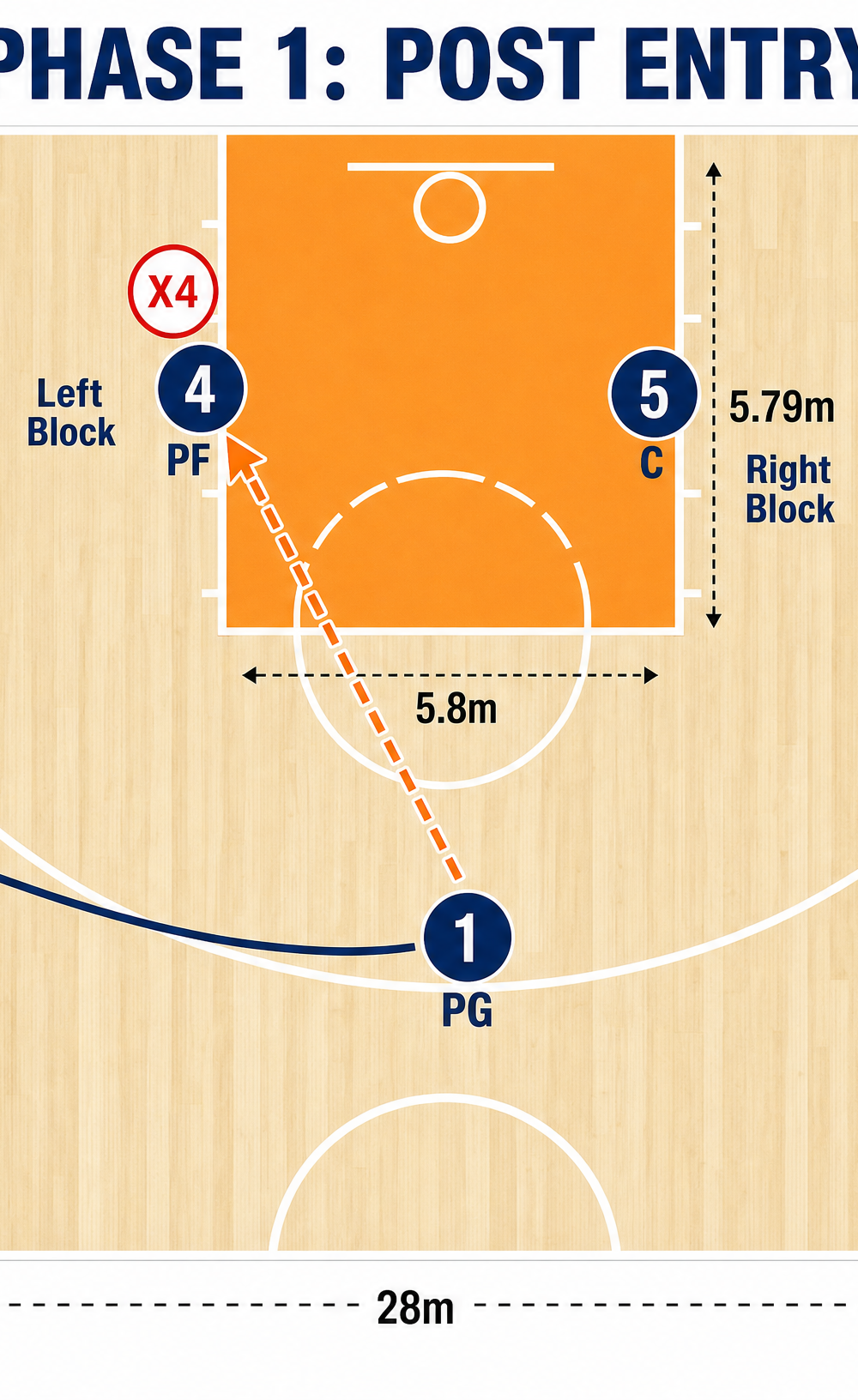
- Court Setup: Standard FIBA half-court (28m x 15m).
- Player Positions:
- Player 1 (PG): Top of the key or wing area, acting as the entry passer.
- Player 4/5 (Post): Starting at the low block (just outside the 5.8m lane).
- Defender (X4): Starting behind or three-quarter fronting the post player.
- Additional players form lines at the guard spot and baseline to rotate in.
3. Step-by-Step Instructions
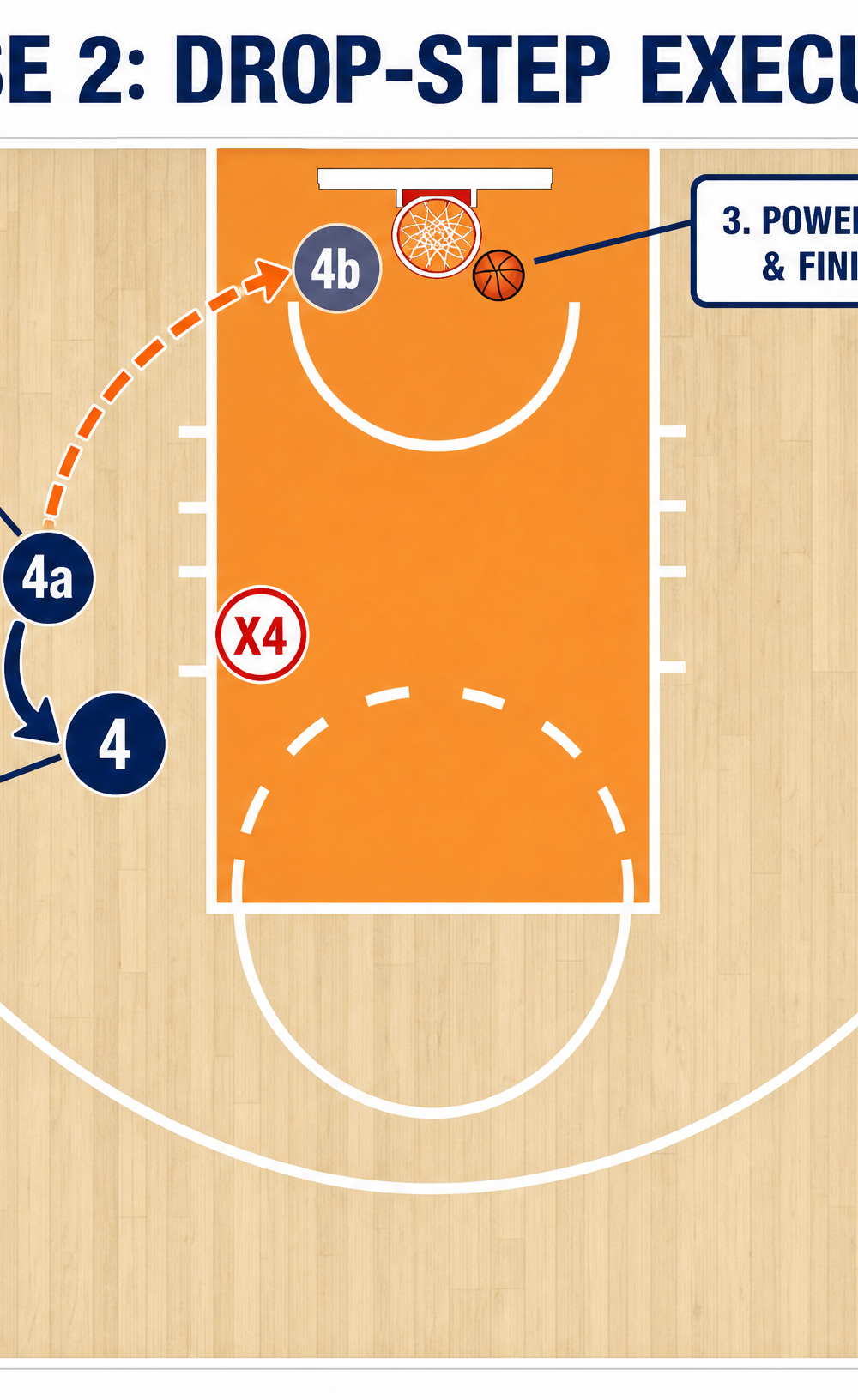
- Establish Position: The post player (4) sprints from the baseline or weak side to the strong side low block. They must establish a wide base, knees bent, creating a target with their outside hand while sealing the defender (X4) with their forearm and hips.
- The Entry Pass: The guard (1) takes one or two dribbles to improve the passing angle and delivers a crisp bounce pass or overhead pass to the post player's target hand.
- Catch and Chin: Upon receiving the ball, the post player immediately chins the basketball (elbows out, ball under the chin) and lands on a two-foot jump stop to establish either foot as the pivot foot.
- Read the Defense: The post player feels the defender's pressure. If the defender is playing high (toward the baseline), the player prepares for a middle move. If the defender is playing middle, the player prepares for a baseline move.
- Execute the Move (The Drop-Step):
- Plant the pivot foot firmly.
- Take a deep, aggressive step with the non-pivot foot, dropping it past the defender's top foot.
- Take one hard power dribble between the legs.
- Explode upward off two feet, protecting the ball with the off-arm, and finish strong off the glass.
- Rebound and Rotate: The post player grabs their own rebound (if missed) or retrieves the made basket, passes to the next guard in line, and rotates to the back of the post line.
4. Key Coaching Points
- Fight for Real Estate: Post play is won before the catch. Players must fight to establish position with at least one foot inside or on the lane line.
- Show a Clear Target: The post player must demand the ball by showing a wide, visible target hand away from the defender.
- Chin the Ball: Immediately protect the basketball upon catching it to prevent guards from swiping down and stripping it.
- Low Man Wins: Maintain a low center of gravity throughout the move. The player who stays lowest has the most power and balance.
- Explode off Two Feet: Finishing off two feet provides maximum power, balance, and the ability to absorb contact through the finish.
5. Common Mistakes
- Catching the Ball Flat-Footed: Players often catch the ball without jumping to a stop, limiting their pivot foot options and slowing down their move.
- Rushing the Move: Post players frequently panic upon catching the ball. They must learn to pause for a split second, read the defense, and then attack decisively.
- Fading Away: Instead of attacking the defender's body, players fade away from contact, resulting in low-percentage, off-balance shots.
- Weak Dribble: Taking a soft or high dribble allows recovering defenders or digging guards to steal the ball. The power dribble must be hard and low.
6. Variations & Progressions
- Progression 1: Add the Middle Hook. Once the baseline drop-step is mastered, instruct the defender to overplay the baseline. The post player must counter by pivoting middle and executing a jump hook.
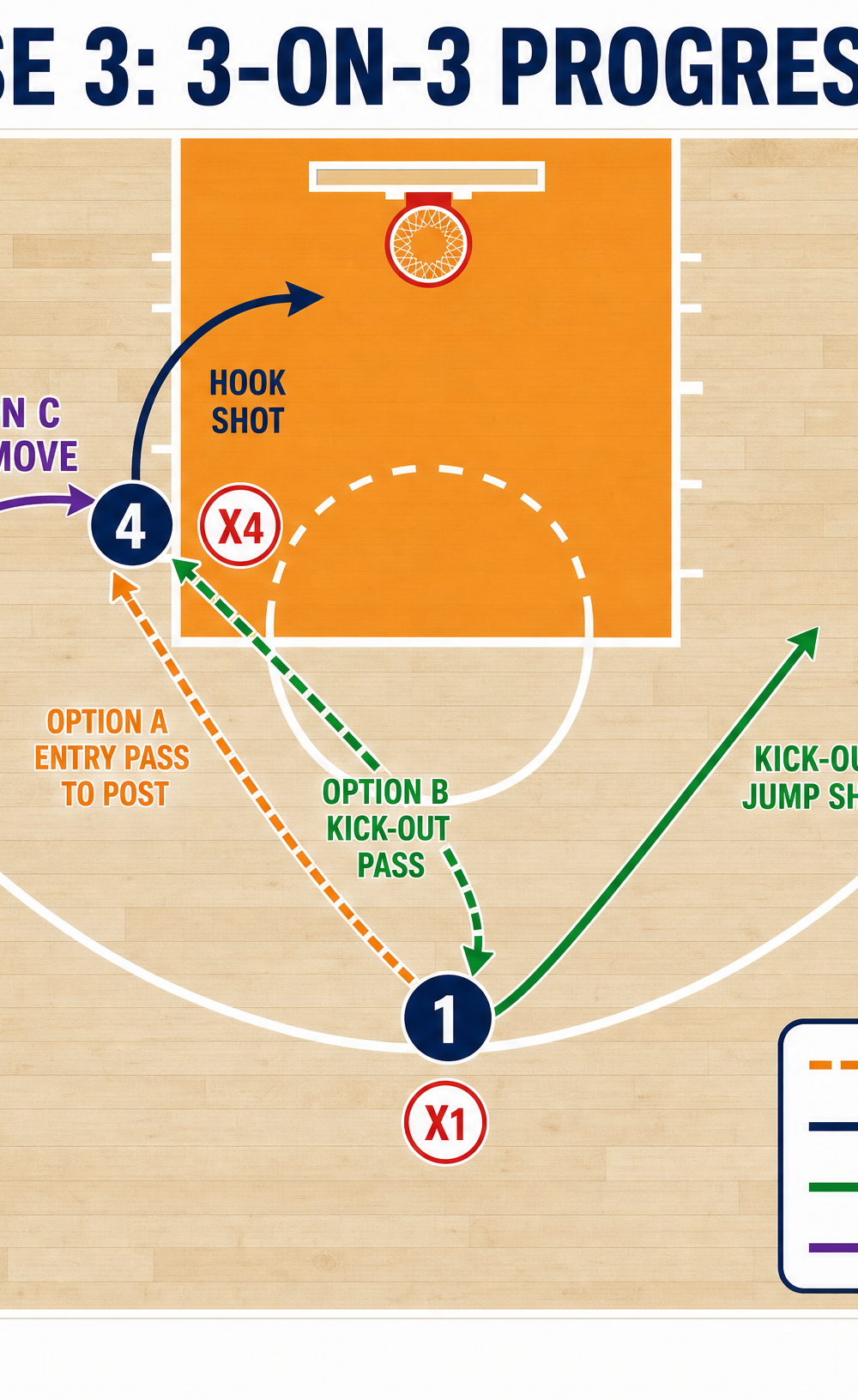
- Progression 2: Live 3-on-3. Introduce a wing player and their defender. Now the post player must read the post defense and the weak-side help. If the double team comes, they must execute a kick-out pass to the open shooter.
7. Age Adaptations
- Under 10 / Under 12: Remove the defender initially. Focus entirely on the footwork of the jump stop, the pivot, and the power dribble without defensive pressure. Use a smaller ball and lower hoop if necessary.
- Under 14 / Under 16: Introduce guided defense where the defender dictates the move but allows the offensive player to execute it. Emphasize reading the defense and finishing through light contact (using a blocking pad).
- Open / Advanced: Play live 1-on-1 in the post with a 3-second shot clock upon the catch. Emphasize finishing through heavy contact, drawing fouls, and making rapid reads against double teams.