Defensive Press Play at Centre Pass
Master the aggressive defensive press at the centre pass to disrupt the opposition's flow, force wide passes, and create game-changing intercept opportunities.

Equipment Needed
Defensive Press Play at Centre Pass
1. Overview
The "Defensive Press Play" at the centre pass is an aggressive, high-intensity strategy designed to disrupt the opposition's first phase of attack. Instead of dropping back into a passive zone, the defending team applies immediate, tight one-on-one pressure across the centre third. The primary goal is to force the attacking team into making a wide, floating pass or a predictable short pass, creating an opportunity for a defensive intercept—most commonly by the Goal Defence (GD) or Wing Defence (WD). This play is particularly effective when the opposition relies on quick, direct passes to their Wing Attack (WA) or Goal Attack (GA).
2. Setup
- Equipment Needed: 1 netball, full court (30.5m x 15.25m), 14 players (7 attackers, 7 defenders), and bibs.
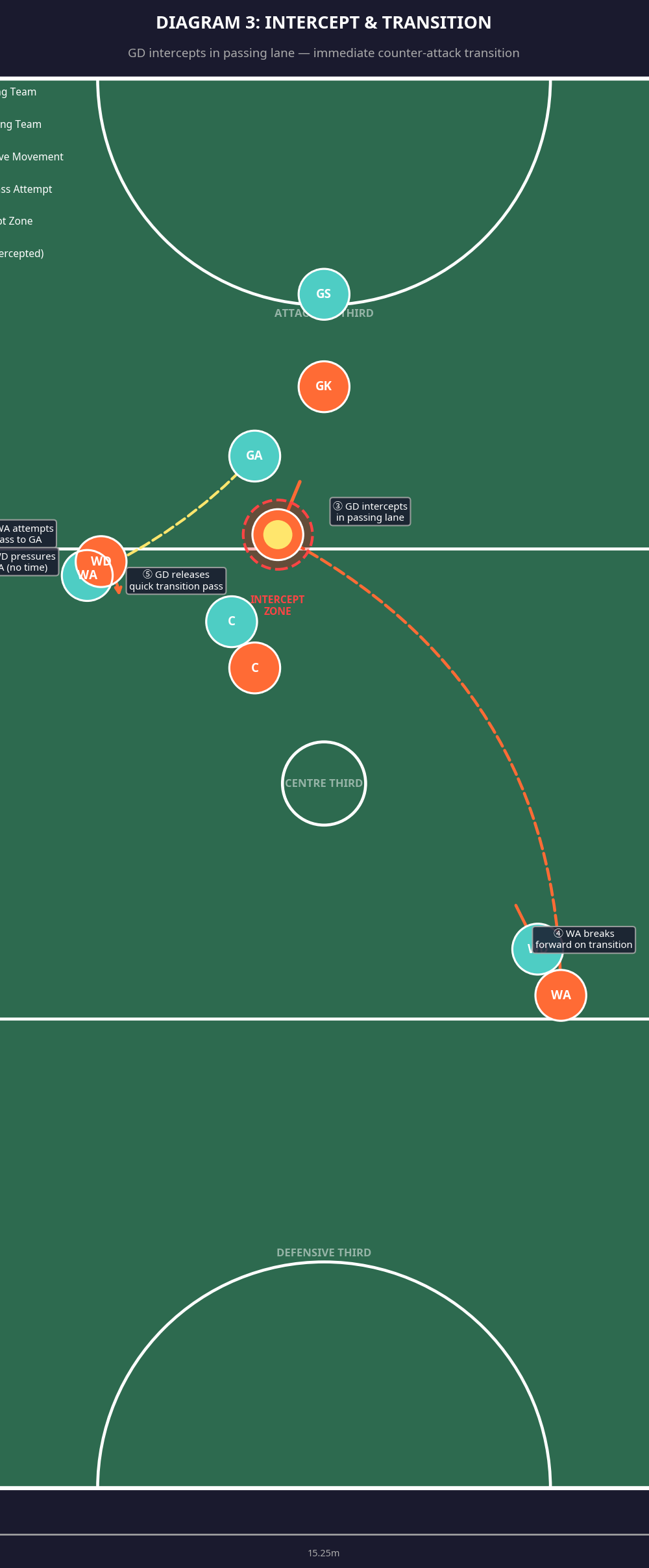
- Court Setup: Standard full-court setup.
- Player Positions:
- Defending C: Sets up tightly on the edge of the centre circle, directly facing the attacking C.
- Defending WD & GD: Positioned slightly on the inside shoulder of their direct opponents (WA and GA), forcing them wide towards the sidelines.
- Defending GK: Drops slightly deeper to cover the long ball to the GS.
- Defending WA: Drops back into the centre third to clog the middle corridor and prepare for the transition.
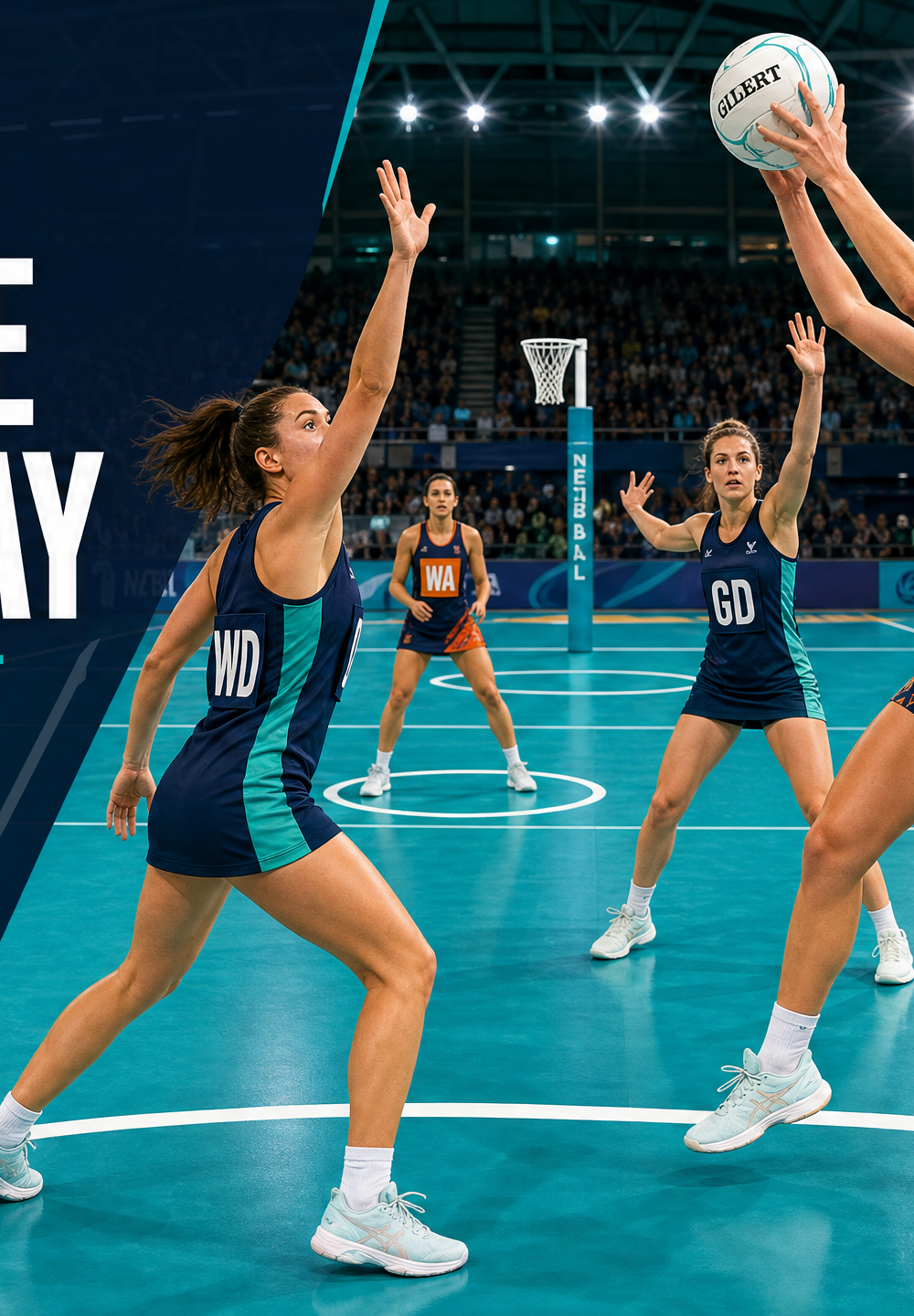
3. Step-by-Step Instructions
- The Setup (Pre-Whistle): All defending players must establish their starting positions before the umpire's whistle. The defensive C stands right on the circle edge, arms ready. WD and GD take an inside-shoulder stance against the attacking WA and GA, denying the middle channel.
- The Whistle & Initial Pressure: As the whistle blows, the defending C immediately dictates the space, shadowing the attacking C's first movement. The WD and GD step up their physical presence, using footwork to force the WA and GA to drive out wide toward the transverse line.
- Forcing the Wide Pass: Due to the tight inside pressure, the attacking C is forced to throw a longer, higher, or wider pass to the WA or GA.
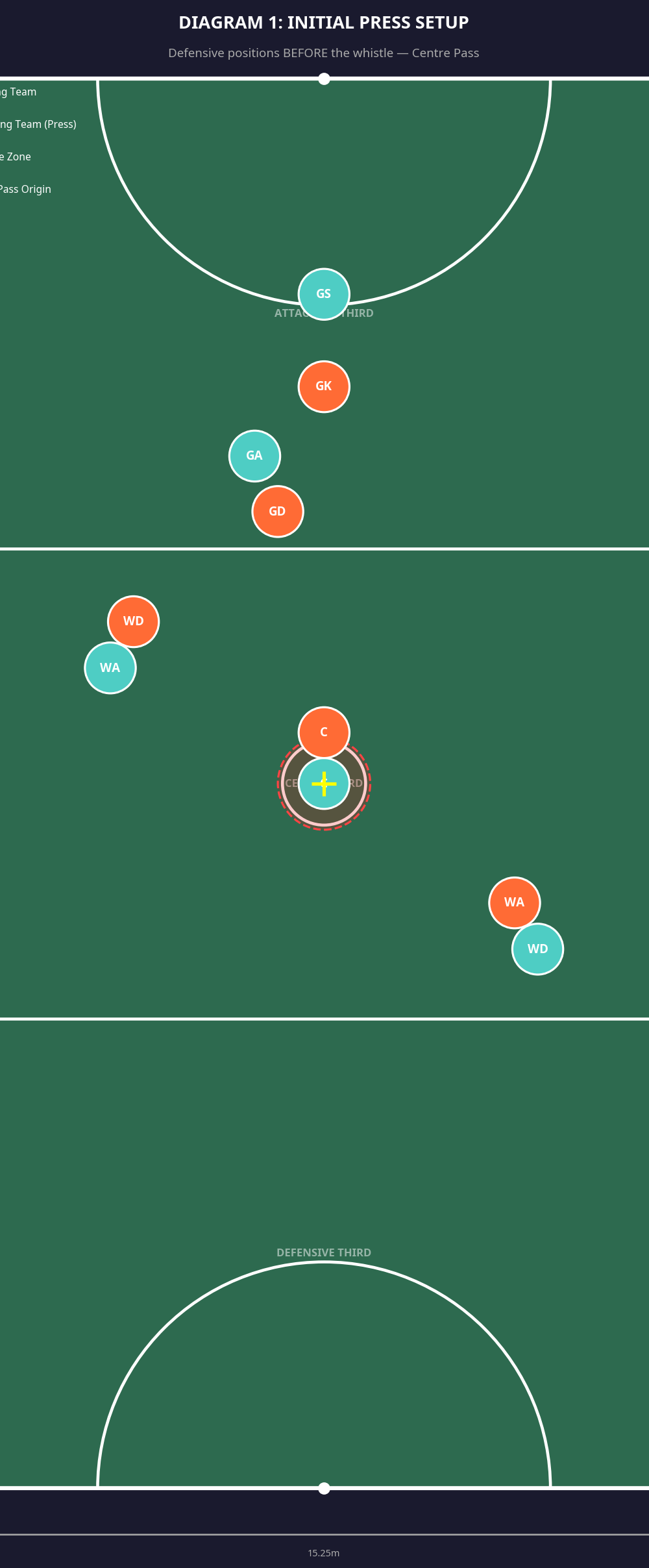
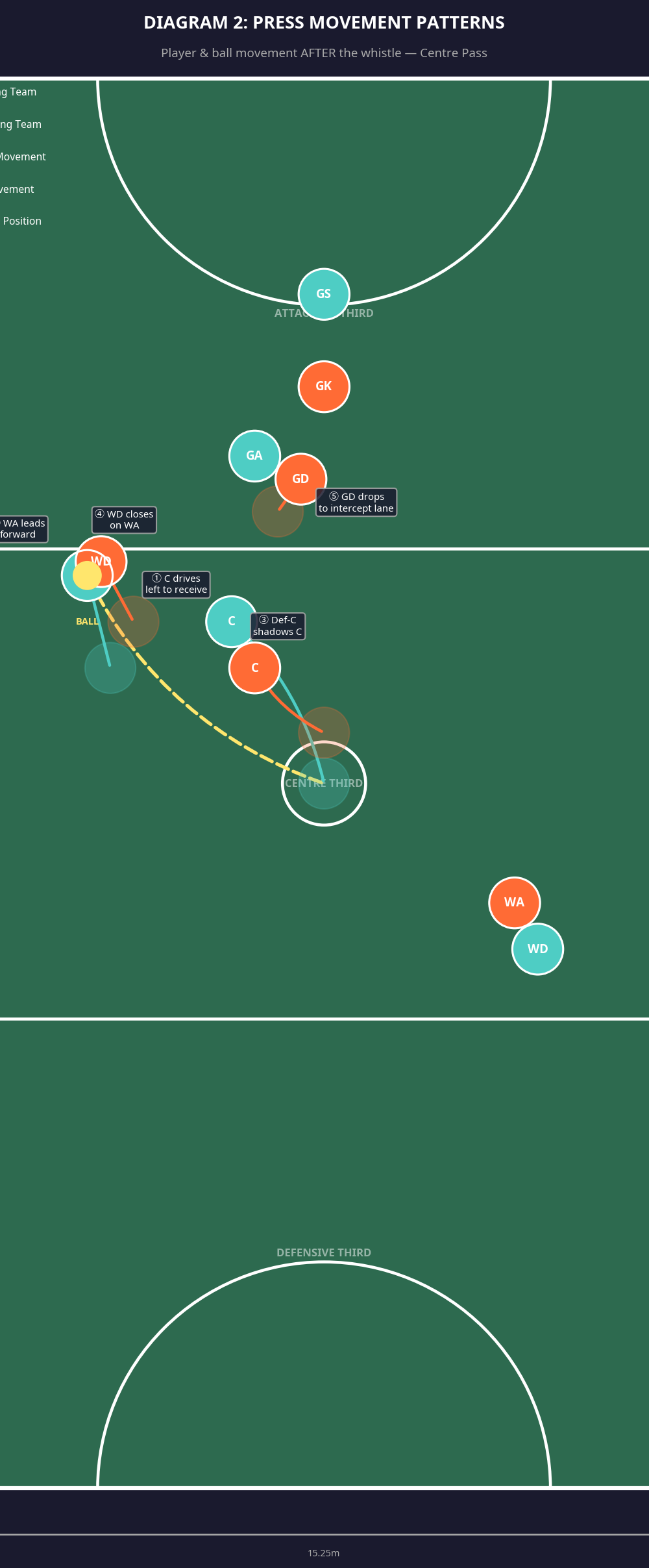
- The Trap & Intercept: As the ball leaves the attacking C's hands, the off-ball defender (often the GD if the pass goes to the WA) reads the flight path. The GD leaves their direct opponent and explodes into the passing lane to take the intercept.
- The Transition: Immediately upon securing the intercept, the GD lands, pivots, and looks for the defending WA or C who should be breaking forward into the attacking third to initiate the counter-attack.
4. Key Coaching Points
- Inside Shoulder Positioning: Defenders must maintain an inside-shoulder position to dictate the attacker's driving path. If you allow the attacker the middle channel, the press is broken.
- Vision and Anticipation: The intercepting player (GD/WD) must keep "open body" vision—seeing both their direct opponent and the player with the ball (the C).
- Commitment to the Intercept: When a defender decides to leave their player to go for the intercept, they must commit 100%. Hesitation leads to being caught out of position.
- Immediate Transition: The moment possession is turned over, the mindset must switch instantly from defense to attack. The first pass after an intercept is crucial.
- Communication: The GK must communicate the positioning of the GA/GS to the GD, giving the GD the confidence to leave their player for the intercept.
5. Common Mistakes
- Watching the Ball, Losing the Player: Defenders get caught ball-watching at the whistle and lose track of their direct opponent's initial drive.
- Over-Committing Early: A defender steps out for an intercept before the ball is actually released, allowing the attacking C to easily adjust and pass to the newly open player.
- Flat Footwork: Defenders standing flat-footed rather than on the balls of their feet, resulting in a slow reaction time when the pass is thrown.
- Lack of Depth from GK: If the GK pushes up too high during the press, it leaves the backspace wide open for a long bomb over the top to the GS.
6. Variations & Progressions
- Progression 1 (The Double Team): If the pass successfully reaches the WA on the sideline, the defending C and WD immediately double-team the WA against the transverse line to force a held ball or a wild pass.
- Progression 2 (The Switch): Introduce a switch between the GD and WD. If the WA and GA cross paths during their drives, the defenders seamlessly hand off their players to maintain the structural integrity of the press.
- Variation 1 (Zone Drop): Start with the appearance of a tight man-on-man press, but at the whistle, the GD and WD drop back three steps into a pseudo-zone, baiting the short pass before closing the trap.
7. Age Adaptations
- Under 10 / Under 12: Focus heavily on the basic man-on-man shadowing and the concept of "inside shoulder." Do not emphasize the flying intercept yet; focus on forcing a held ball through 3 seconds of tight marking.
- Under 14 / Under 16: Introduce the concept of reading the pass and leaving the opponent for the intercept. Work on the timing of the jump and the immediate transition to attack.
- Open / Advanced: Execute the full press with complex variations, including double-teams on the sideline and seamless defensive switching. The speed of transition from intercept to goal should be a primary focus.