Mastering the Defensive Shape Transition When Pressed: A 4-4-2 Mid-Block Guide
Learn how to organise your team to absorb high pressure in a compact 4-4-2 mid-block, trigger traps, and transition ruthlessly into attack.
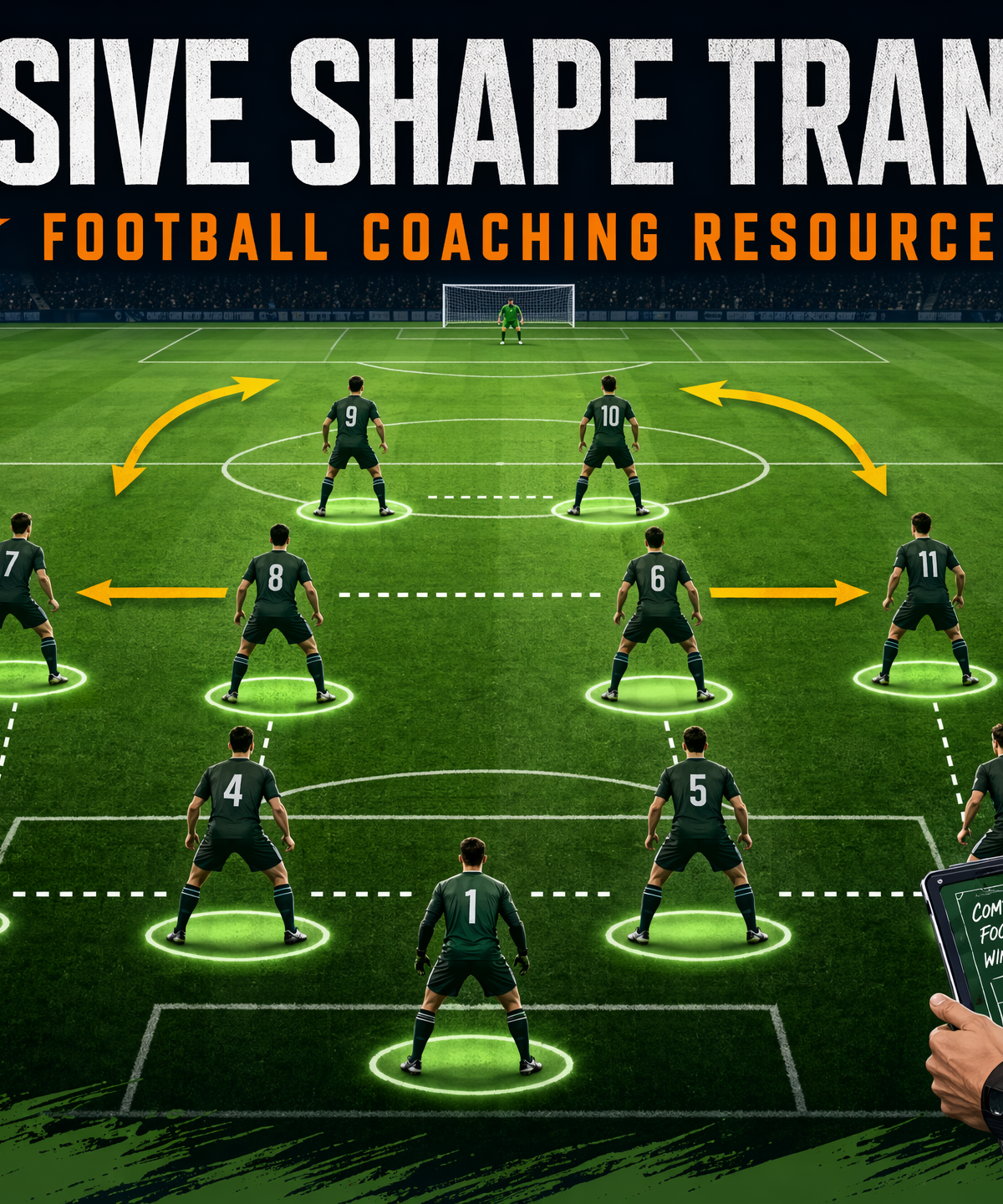
Equipment Needed
1. Overview
In modern football, dealing with a high, aggressive press is a fundamental requirement for any successful team. This set play focuses on the defensive shape transition when pressed, specifically utilizing a compact 4-4-2 mid-block.
The objective is twofold: first, to absorb the opponent's pressure by maintaining a disciplined, narrow shape that forces play out wide; second, to use specific pressing triggers to win the ball back in advantageous areas and immediately launch a counter-transition. This session will teach your players how to recognize when to drop, when to squeeze, and how to exploit the spaces left behind by an over-committed pressing team.
2. Setup

- Pitch Area: Full pitch (approximately 105m x 68m), focusing primarily on the defensive and middle thirds.
- Players: 22 players (11v11) or a minimum of 8v8 (adjusting pitch size accordingly).
- Equipment:
- Full-size goals (2)
- Cones/Markers to outline the defensive and middle thirds, and specific pressing zones
- Bibs (2 contrasting colours)
- Supply of footballs positioned around the pitch perimeter
- Starting Positions: The defending team sets up in a structured 4-4-2 mid-block. The attacking team starts with possession in their own half, preparing to build up and press high when possession is lost.
3. Step-by-Step Instructions
Phase 1: Establishing the Mid-Block
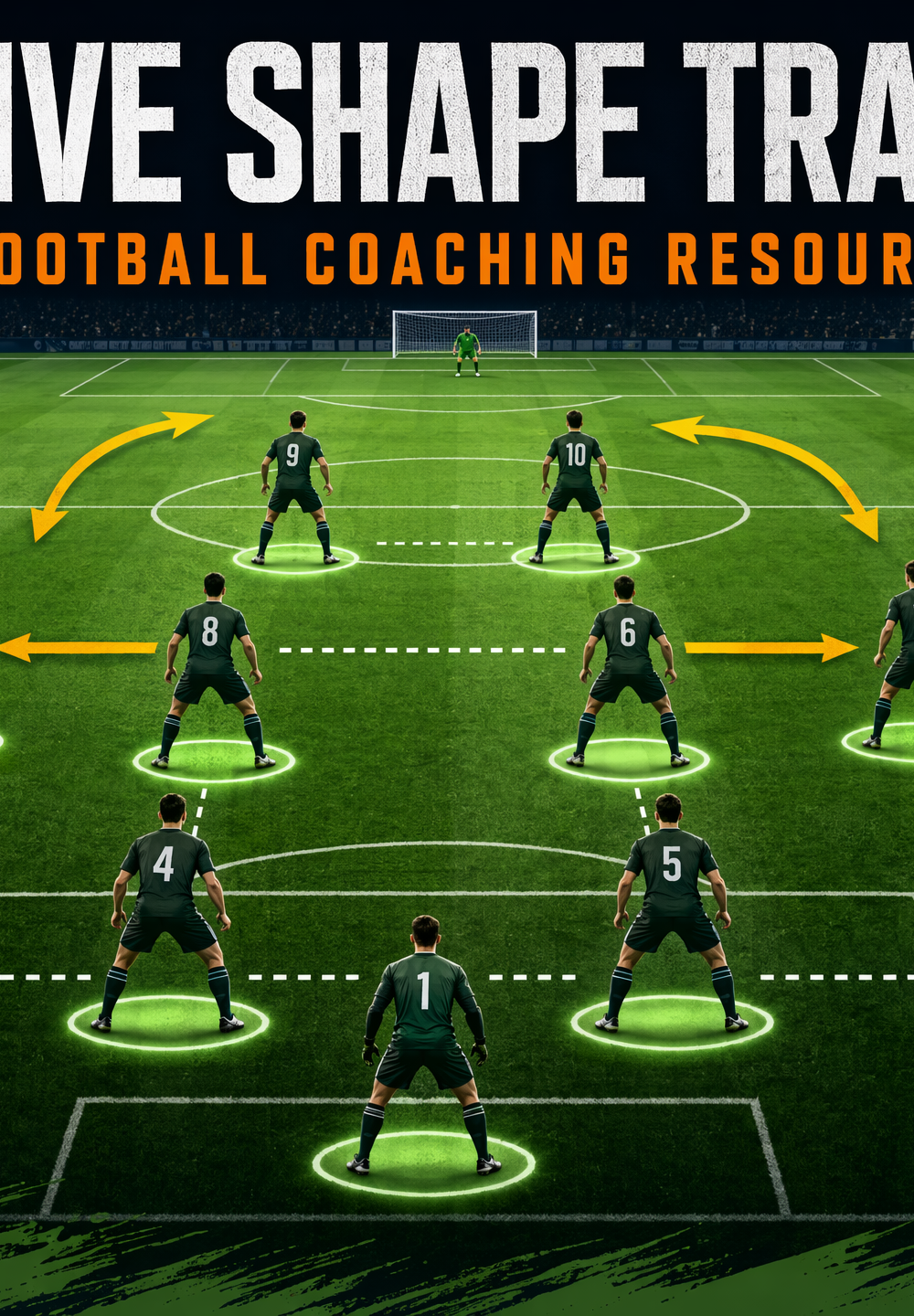
- Starting Shape: The defending team drops into a compact 4-4-2 mid-block. The two centre forwards (CF 9 & 10) position themselves around 55m from their own goal, cutting off passes to the opponent's holding midfielder.
- Horizontal Compactness: The midfield four (RM 7, CM 8, CM 6, LM 11) stay narrow, roughly 40m from goal, allowing no more than 10-15 metres between players laterally.
- Vertical Compactness: The back four (RB 2, CB 4, CB 5, LB 3) hold a line 25m from goal. The distance between the defensive line and the forward line should not exceed 30 metres.
- Shifting: As the attacking team circulates the ball, the entire defensive block shifts collectively towards the ball side, leaving the furthest attacking player unmarked but denying any central penetration.
Phase 2: The Press Trigger and Response
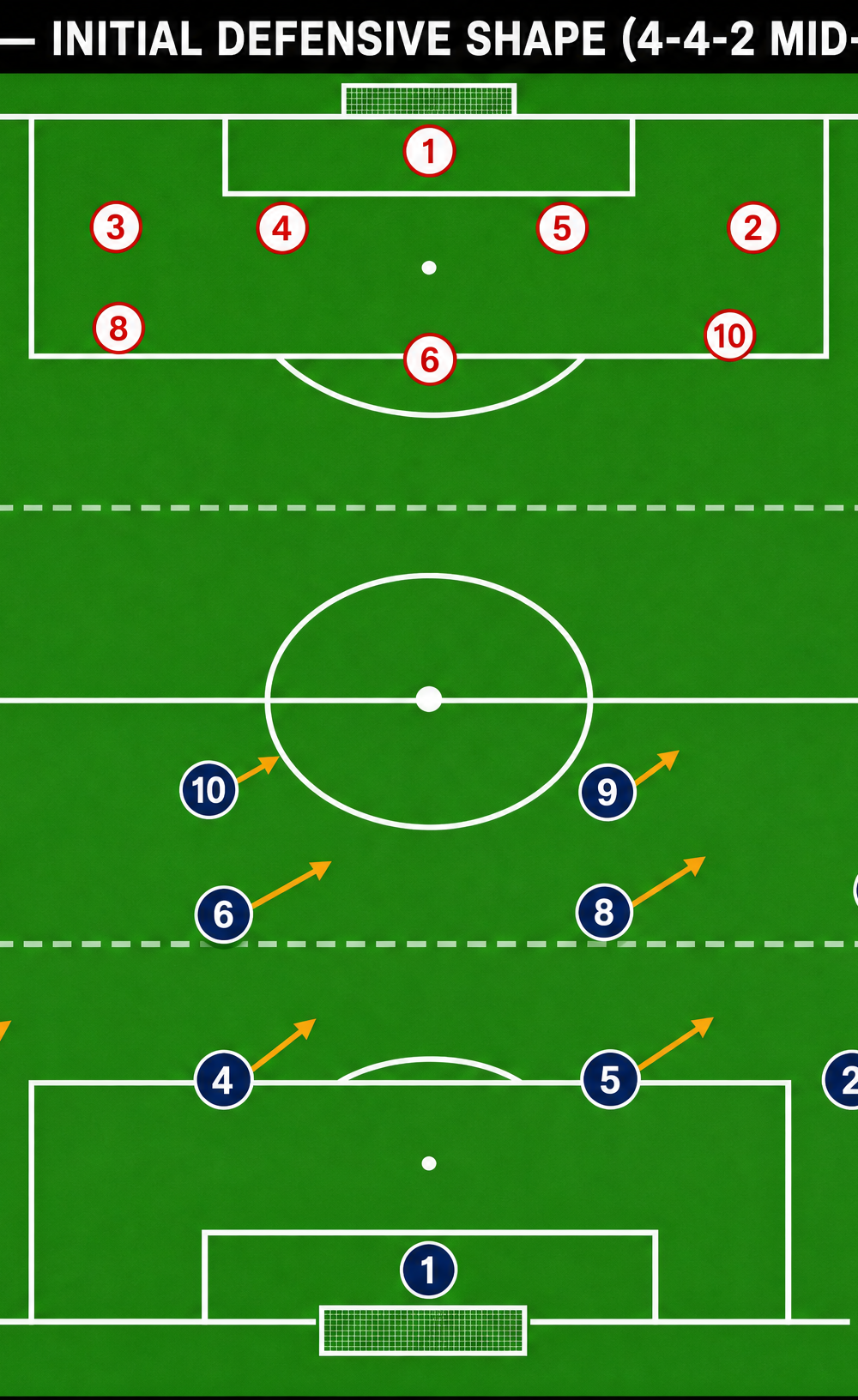
5. Identifying the Trigger: A pressing trigger occurs—for example, a poor touch by an opposing centre-back, a slow sideways pass, or a pass played backwards.
6. Initiating the Press: The nearest CF (e.g., 9) aggressively presses the ball carrier. The second CF (10) shifts to block the passing lane to the midfield pivot.
7. Midfield Squeeze: The ball-side winger (e.g., LM 11) steps up to press the full-back, while the central midfielders (6 & 8) push up to tightly mark their opposite numbers, denying any easy escape passes.
8. Defensive Line Adjustment: The defensive line steps up 5-10 metres to compress the space, ensuring the midfield is supported and offside traps are active. The Goalkeeper (1) sweeps 8-10m off their line.
Phase 3: Winning the Ball and Counter-Transition
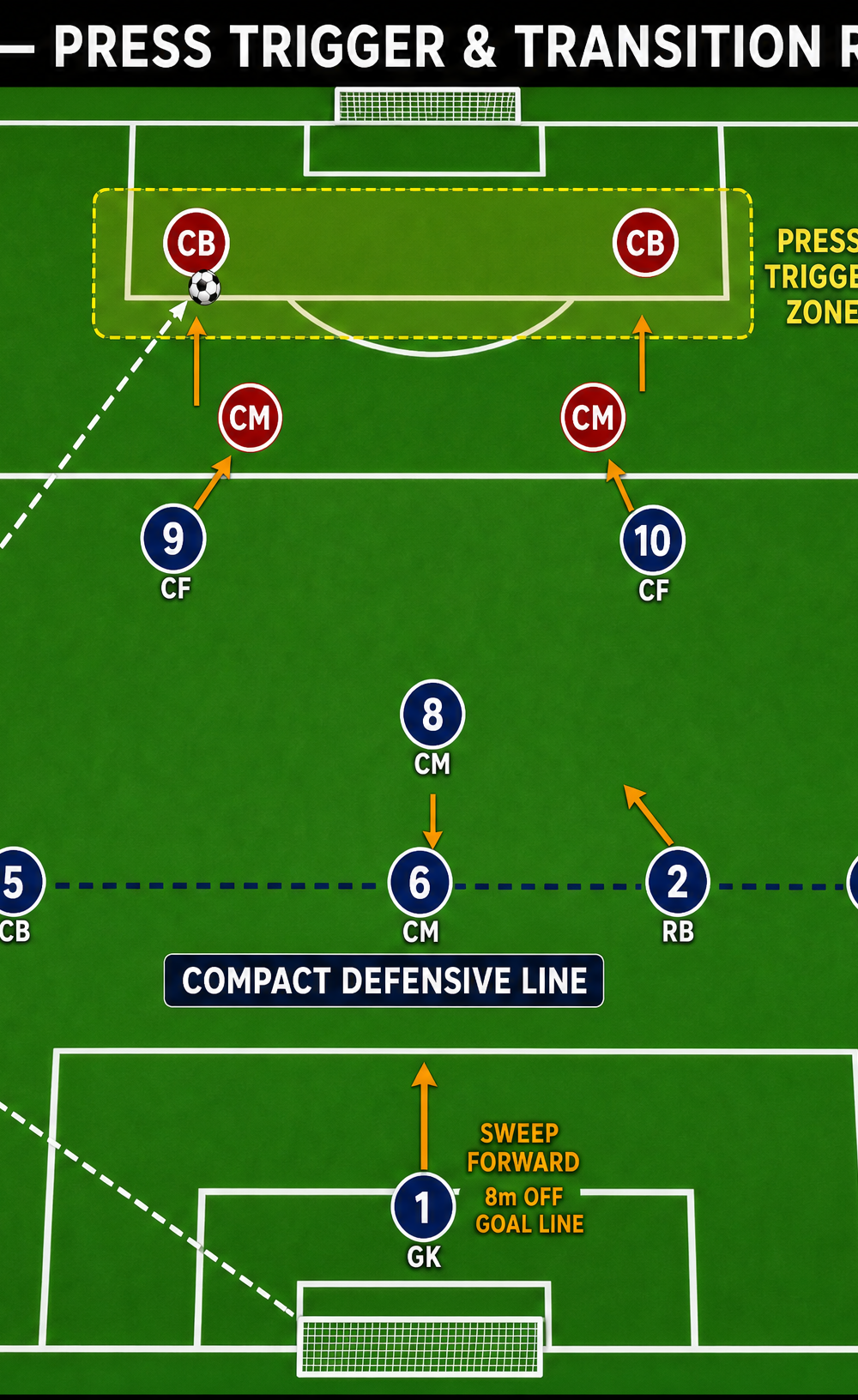
9. The Turnover: The intense, coordinated pressure forces a turnover in the middle third (e.g., CM 8 wins the ball).
10. Immediate Forward Look: Upon winning the ball, the first thought must be vertical. CM 8 immediately looks for a forward pass.
11. Exploiting Space: CF 9 makes a penetrating run in behind the disorganized opponent's defensive line. Simultaneously, the opposite winger (RM 7) makes a diagonal run into the channel, creating a 3v2 overload on the counter.
12. Supporting the Attack: The full-backs (2 & 3) push forward rapidly to provide width, while the remaining midfielders offer support underneath the ball.
4. Key Coaching Points
- Maintain Compactness: The distance between the defensive and forward lines must remain tight (under 30m). If the lines stretch, the opponent will play through the middle.
- Communication is Crucial: The centre-backs must dictate the height of the defensive line, shouting "Step up!" or "Drop!" based on the pressure on the ball.
- Recognize the Triggers: Players must react instantly to pressing triggers (bad touch, backward pass, bouncing ball). Hesitation allows the opponent to escape.
- Intensity on Transition: The moment the ball is won, the transition from defense to attack must be explosive. The first pass should ideally be forward to exploit the disorganized opposition.
- Body Shape: Defenders must maintain an open body shape, ready to drop quickly if the ball is played over the top, or step in to intercept.
5. Common Mistakes
- Pressing Individually: One player pressing without support from the rest of the team creates gaps that the opponent can easily exploit. The press must be collective.
- Defensive Line Dropping Too Deep: If the back four drops too early or too deep while the midfield presses, huge spaces open up between the lines.
- Slow Transition: Winning the ball but taking too many touches or playing negative passes allows the opponent time to recover their defensive shape.
- Ball Watching: Players focusing solely on the ball and losing track of runners on their blind side.
6. Variations & Progressions
- Progression 1: Add a Time Limit: Once the ball is won, the defending team has 8 seconds to get a shot on goal. This encourages rapid, vertical counter-attacks.
- Progression 2: Overload the Attack: Start the practice with the attacking team having a numerical advantage (e.g., 8v6 in the opponent's half) to increase the difficulty of defending and pressing.
- Variation 1: Change the Block Height: Practice dropping into a deeper low block (edge of the penalty area) and transitioning from there, which requires longer counter-attacking runs.
7. Age Adaptations
- Under 10s / Under 12s: Focus primarily on the basic shape (compactness) and the concept of shifting together as a unit. Introduce simple pressing triggers like "press when the ball goes out wide."
- Under 14s / Under 16s: Demand higher tactical understanding. Focus on the distances between lines, specific pressing traps, and the speed of the counter-transition.
- Open / Senior: Expect flawless execution of the tactical plan. Introduce complex variations, such as asymmetrical pressing shapes or specific man-marking roles within the zone.