Mastering the First Phase: The Crash & Wrap Attacking Backs Play
Equip your backline with a versatile first-phase attacking structure that creates overlaps, manipulates defensive spacing, and ensures front-foot ball.

Equipment Needed
1. Overview
Securing clean, front-foot ball off first-phase possession (scrums and lineouts) is critical for dictating the tempo of a match. This set play, "The Crash & Wrap," is designed to manipulate the defensive line by offering two distinct, hard-to-read options from the same initial formation.
By having the Inside Centre (12) act as the primary strike runner, you immediately force the defence to commit tacklers. From this foundation, the play branches into two primary variations: a direct "Crash & Shift" to dent the line, or an "Outside Wrap" by the Outside Centre (13) to create a numerical advantage (overlap) wider out. This structure is highly effective when you have a strong ball-carrying 12 and a pacey, intelligent 13.
2. Setup
Equipment Needed:
- 1 Rugby ball (plus spares)
- 8-10 cones for marking alignment and defensive gaps
- Tackle shields or hit shields (if running against a passive defence in training)
Pitch Setup:
- Utilize a standard 100m x 70m pitch area.
- Set up a ruck or a static scrum/lineout simulation near the 15m line to give the backs plenty of open field to work with.
Player Positions:
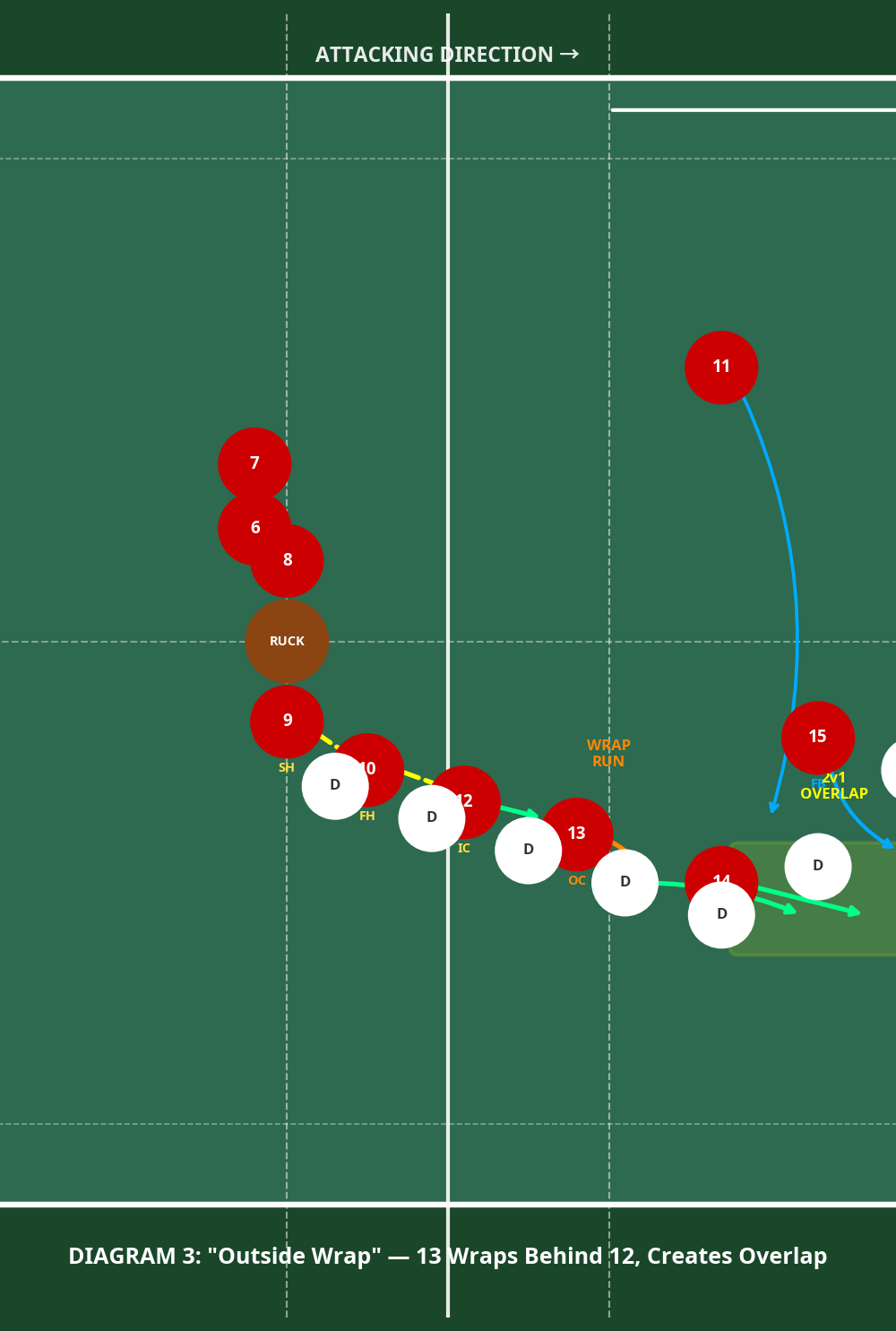
- 9 (Scrum Half): At the base of the ruck/scrum.
- 10 (Fly Half): Standing relatively flat, about 5-7 metres deep and 5 metres wide of the 9.
- 12 (Inside Centre): Positioned to hit a hard, straight line just off the shoulder of the 10.
- 13 (Outside Centre): Starts slightly deeper and wider than the 12, ready to run a decoy or wrap.
- 14/11 (Wingers): Holding width to stretch the defence.
- 15 (Fullback): Sweeping in behind as a secondary playmaker or late support runner.

3. Step-by-Step Instructions
Variation A: The Crash & Shift
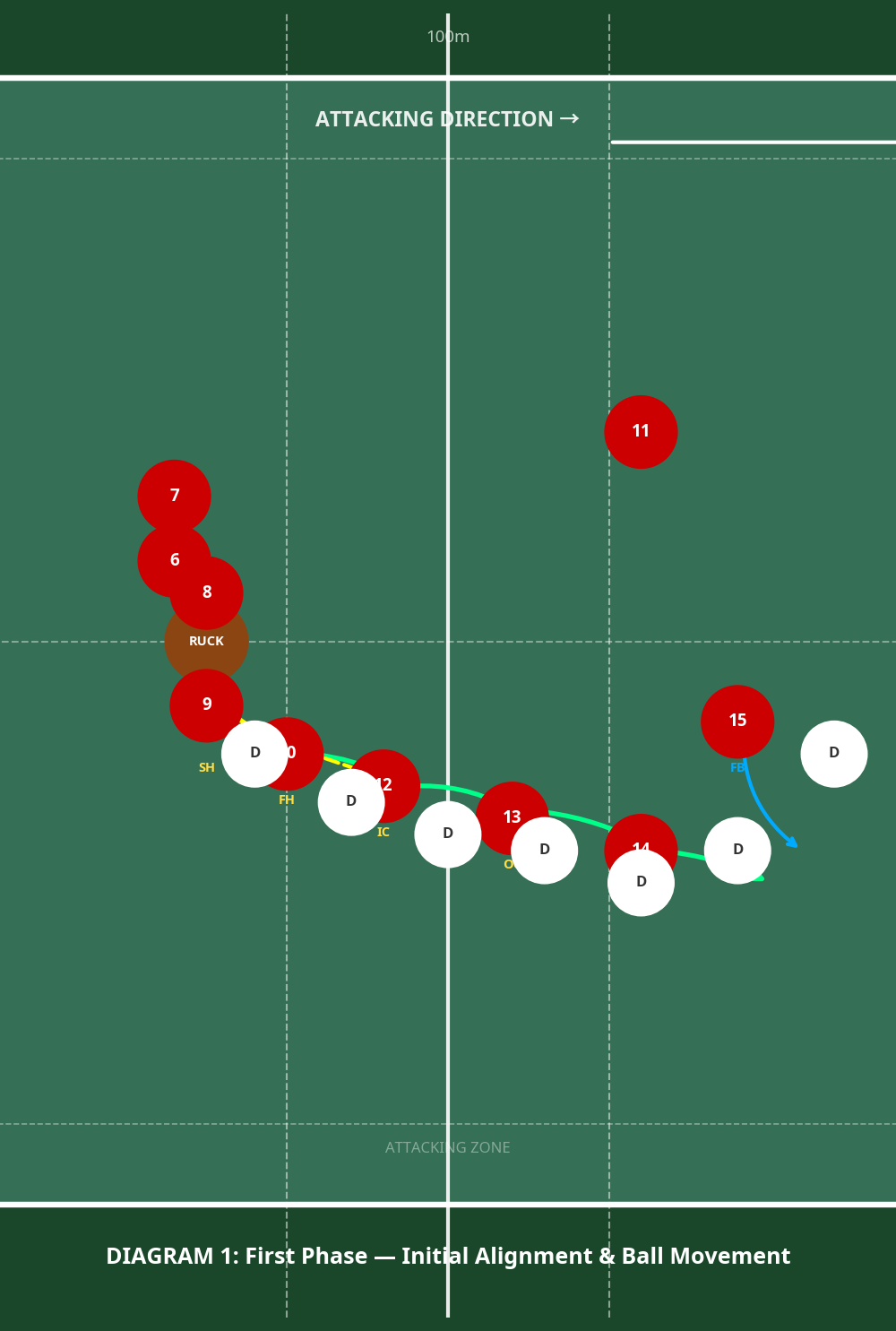
This variation aims to get over the gainline quickly and reset for a fast second phase, or to offload in contact if the defence bites hard on the 12.
- The Delivery: The 9 delivers a crisp, fast pass to the 10.
- The Engagement: The 10 takes the ball to the line, engaging the opposing Fly Half and Inside Centre. The 10 must square their shoulders to the opposition try line.
- The Crash Run: The 12 runs a hard, direct "crash" line into the gap between the defending 10 and 12. The 10 passes flat to the 12 just before contact.
- The Shift: As the 12 takes contact, the 13, 14, and 15 immediately shift wider, anticipating an offload or preparing for a lightning-fast ruck.
- The Support: The loose forwards (6, 7, 8) or the 11 coming off the blindside must track the 12's run to secure the ruck if an offload isn't possible.
Variation B: The Outside Wrap
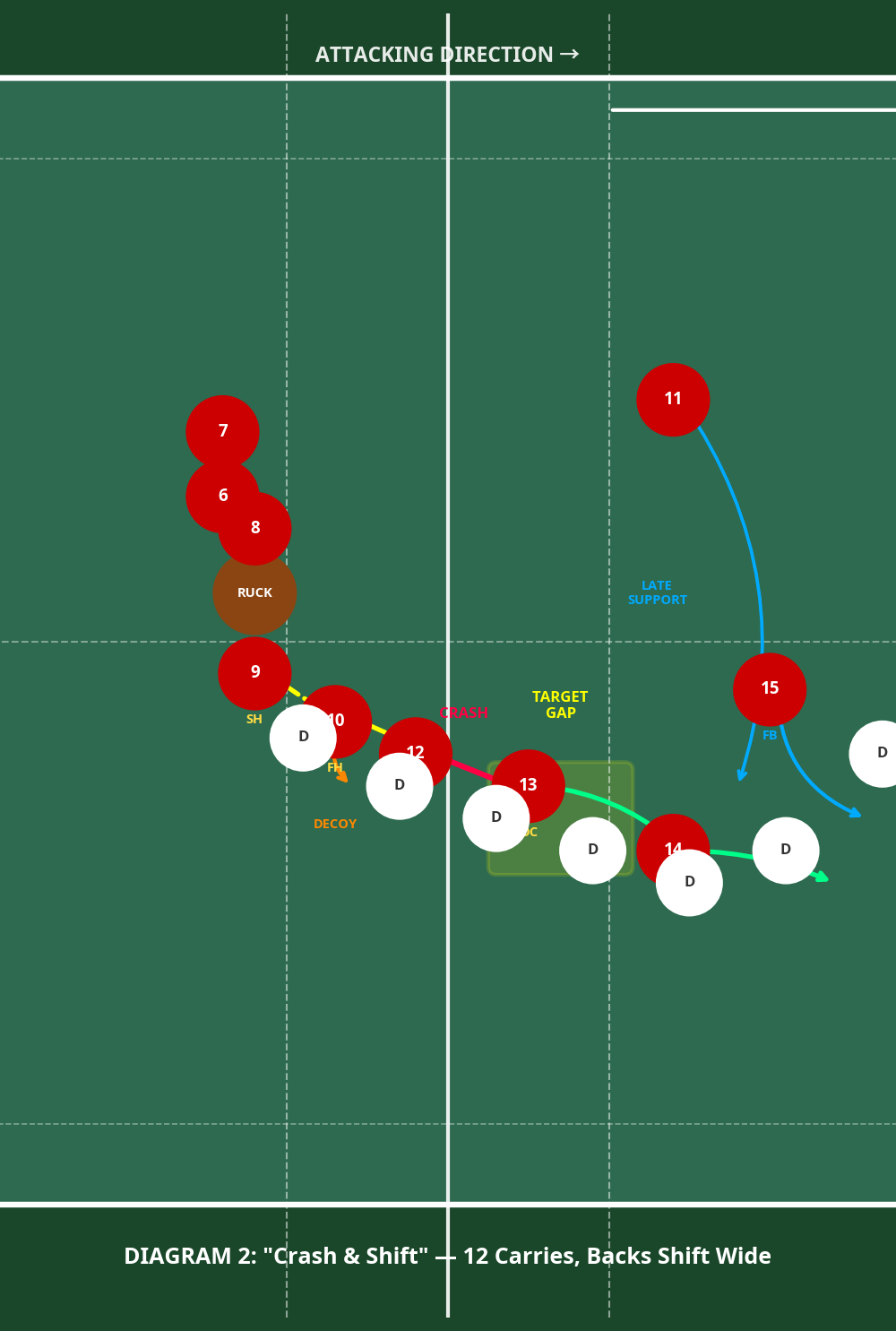
This variation uses the 12 as a decoy or a pivot to release the 13 into space, exploiting defences that rush up to stop the crash ball.
- The Delivery: The 9 passes to the 10, who again squares up the defence.
- The Pivot: The 10 passes to the 12. The 12 catches the ball but instead of taking contact, steps slightly inward to fix the defenders.
- The Wrap: The 13, who started deep, accelerates and runs a tight, curved "wrap" line directly behind the 12.
- The Pop Pass: The 12 delivers a soft, sympathetic pop pass backward to the wrapping 13.
- The Overlap: The 13 bursts into the space outside the defending 12. With the 14 holding width and the 15 joining the line, the attack now has a 3-on-2 or 2-on-1 overlap against the defending 13 and winger.
4. Key Coaching Points
- Square Shoulders: The 10 and 12 must keep their hips and shoulders pointing directly up the pitch until the moment of the pass. Drifting sideways makes it easy for the defence to slide.
- Timing of the Wrap: The 13 must not overrun the 12. The acceleration should happen after the 12 catches the ball, ensuring the 13 hits the gap at maximum velocity.
- Depth and Alignment: Starting too flat will result in the attack being swallowed up by a blitz defence. Ensure players start deep enough to build pace.
- Communication: The 10 should call the variation (Crash or Wrap) based on how the defence is aligning. If the defence is narrow, call the Wrap. If they are drifting wide, call the Crash.
- The Quality of the Pop Pass: The pass from 12 to 13 in the Wrap variation must be soft and easy to catch, not a bullet pass. It should hang in the air slightly for the 13 to run onto.
5. Common Mistakes
- Drifting: Attackers running diagonally toward the touchline rather than straight, effectively defending themselves by running out of space.
- Telegraphing the Play: The 12 looking back at the 13 too early, alerting the defence to the wrap.
- Poor Support Lines: Forwards failing to anticipate the 12's crash run, resulting in isolated ball carriers and turnovers.
- Static Catching: Catching the ball while standing still. All receivers must be moving forward when they take the pass.
6. Variations & Progressions
- The Dummy Wrap (Progression): Run the Wrap variation, but have the 12 dummy the pop pass to the 13 and instead step inside the sliding defence.
- Adding the Fullback (Variation): Instead of the 13 wrapping, have the 13 run a hard decoy line, and have the 15 wrap behind both the 12 and 13 to enter the line out wide.
- Defensive Pressure (Progression): Start with passive defenders (holding shields), then progress to touch defence, and finally full-contact opposed training to test decision-making under pressure.
7. Age Adaptations
- Under 10s / Under 12s: Focus purely on the "Crash" variation. Emphasize running straight, catching on the move, and supporting the ball carrier. The wrap may be too complex.
- Under 14s: Introduce the "Wrap" variation, but walk through it slowly. Use cones to dictate the exact running lines for the 12 and 13.
- Under 16s / Open: Run the full play with options. Give the 10 and 12 the autonomy to read the defence and call the appropriate variation on the fly.