Slalom Dribble & Precision Finishing: The Ultimate Attacking Drill
Develop close ball control, agility, and clinical finishing under pressure with this high-intensity attacking drill suitable for all age groups.
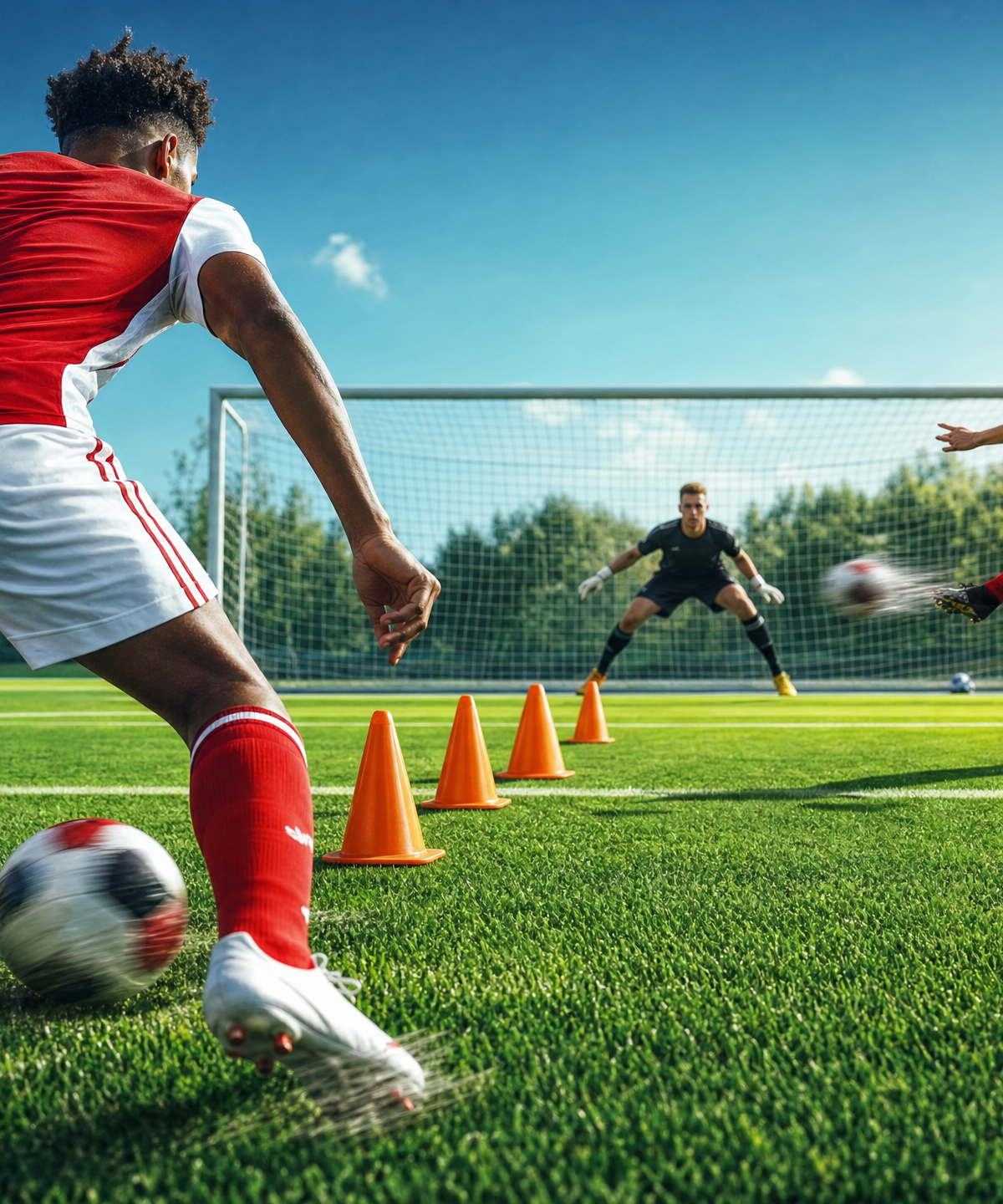
Equipment Needed
1. Overview
The Slalom Dribble & Precision Finishing drill is a fundamental yet highly effective attacking exercise designed to improve a player's close ball control, agility, and ability to transition smoothly from dribbling into a clinical finish.
This drill bridges the gap between isolated technical work and match-realistic scenarios. By forcing players to navigate a tight slalom course before executing a shot, coaches can observe and correct the critical micro-moments: the final touch out of the dribble, the setup touch, the head check to observe the goalkeeper's position, and the strike itself. It is best utilized during the technical or skill-development phase of a training session, serving as an excellent precursor to small-sided games or opposed finishing exercises.
2. Setup
Proper setup is crucial to ensure the drill flows smoothly and players get maximum repetitions without excessive standing around.
Equipment Needed
- Cones: 6-8 tall orange cones for the slalom course, plus 1 starting cone.
- Balls: A minimum of 6-8 footballs placed at the starting cone.
- Goal: 1 full-size goal (7.32m x 2.44m).
- Bibs: Optional, depending on progressions.
Pitch Dimensions & Layout
- Location: Attacking third of the pitch, utilizing the penalty area and the space immediately outside it.
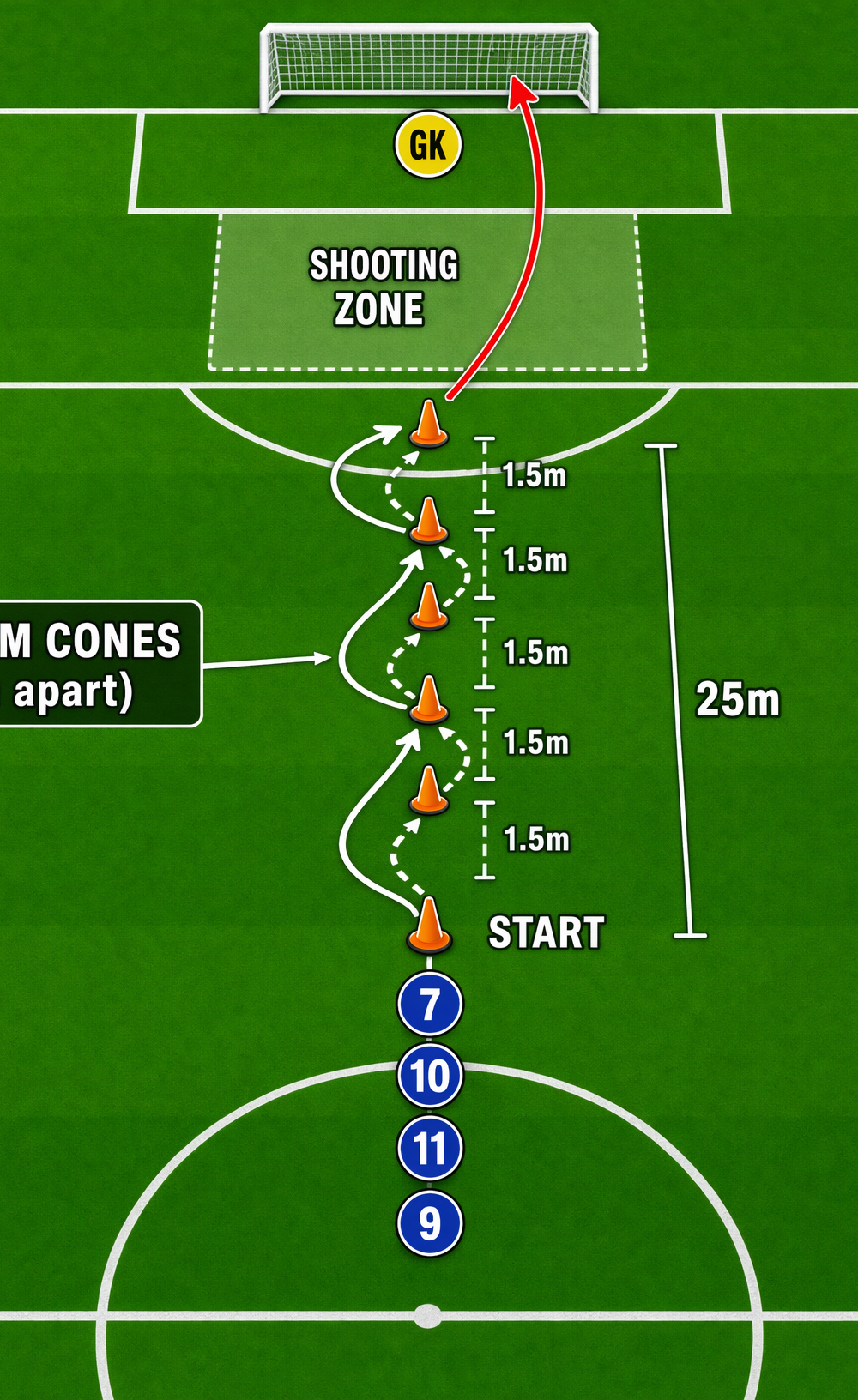
- The Slalom: Place the starting cone approximately 25-30 metres from the goal line, centrally located. Set up 6 slalom cones in a zigzag pattern, spacing them exactly 1.5 metres apart. The final cone should be positioned roughly 18-20 metres from the goal (just outside the penalty area), creating a designated 'Shooting Zone'.
- Player Positions: The goalkeeper (GK) starts in goal. All outfield players (e.g., numbers 7, 9, 10, 11) form a single queue behind the starting cone, each with a ball (or balls readily available next to the start).
3. Step-by-Step Instructions
- Starting Position: The first player in line stands at the starting cone with a ball at their feet. The goalkeeper assumes a ready stance.
- The Slalom: On the coach's whistle or command, the player begins dribbling through the slalom cones. They must weave in and out of every cone, keeping the ball close and using both the inside and outside of both feet.
- The Exit Touch: As the player rounds the final cone, they must take a deliberate, slightly heavier touch out of their feet and into the 'Shooting Zone'. This touch is critical; it must be far enough ahead to allow a natural running stride into the shot, but close enough to retain control.
- The Strike: Without breaking stride, the player strikes the ball towards the goal. The focus should be on accuracy over pure power, aiming for the corners.
- Rotation: After shooting, the player immediately retrieves their ball (or jogs around the outside of the drill area to collect a spare) and joins the back of the queue. The next player in line starts their run as soon as the previous player takes their shot.
4. Key Coaching Points
To maximize the effectiveness of this drill, coaches must focus on the following critical details:
- Close Control & Agility: Emphasize keeping the ball within playing distance (no more than half a metre) while navigating the cones. Players should use quick, choppy steps and drop their hips slightly to change direction efficiently.
- Use of Both Feet: Encourage players to use the inside and outside of both feet. A common flaw is over-relying on the dominant foot, which slows down the dribble and makes the player predictable.
- The Setup Touch: The touch exiting the final cone is the most important part of the drill. It must break the rhythm of the dribble and set the ball perfectly for a strike. "Touch out of your feet, head up, strike!"
- Head Up Before Shooting: Players must get their head up briefly after the setup touch to locate the goalkeeper and pick a corner. Shooting blindly reduces the chance of scoring significantly.
- Technique Over Power: Prioritize a clean, accurate strike using the instep or laces over simply smashing the ball. Accuracy beats power when finishing from the edge of the box.
5. Common Mistakes
Watch out for these frequent errors and correct them immediately:
- Dribbling Too Fast/Losing Control: Players often try to sprint through the cones, resulting in heavy touches and a breakdown of the drill. Correction: "Slow down to speed up. Control first, then accelerate out of the final cone."
- Looking Down Constantly: Players staring at the ball cannot see the goal or the goalkeeper. Correction: "Keep your chin up. Glance at the ball, but keep scanning the space ahead."
- Poor Setup Touch: Taking a touch that is too close (getting the ball stuck under their feet) or too far (allowing the goalkeeper to close down the angle). Correction: "Punctuate the dribble. Make that last touch deliberate and angled towards your shooting foot."
- Leaning Back on the Shot: This causes the ball to fly over the crossbar. Correction: "Get your knee and chest over the ball as you strike through it."
6. Variations & Progressions
Once the players have mastered the basic drill, introduce these progressions to increase the cognitive load and match realism:
- Progression 1: Weak Foot Only: Force players to dribble and finish using exclusively their non-dominant foot. This is crucial for developing complete attackers.
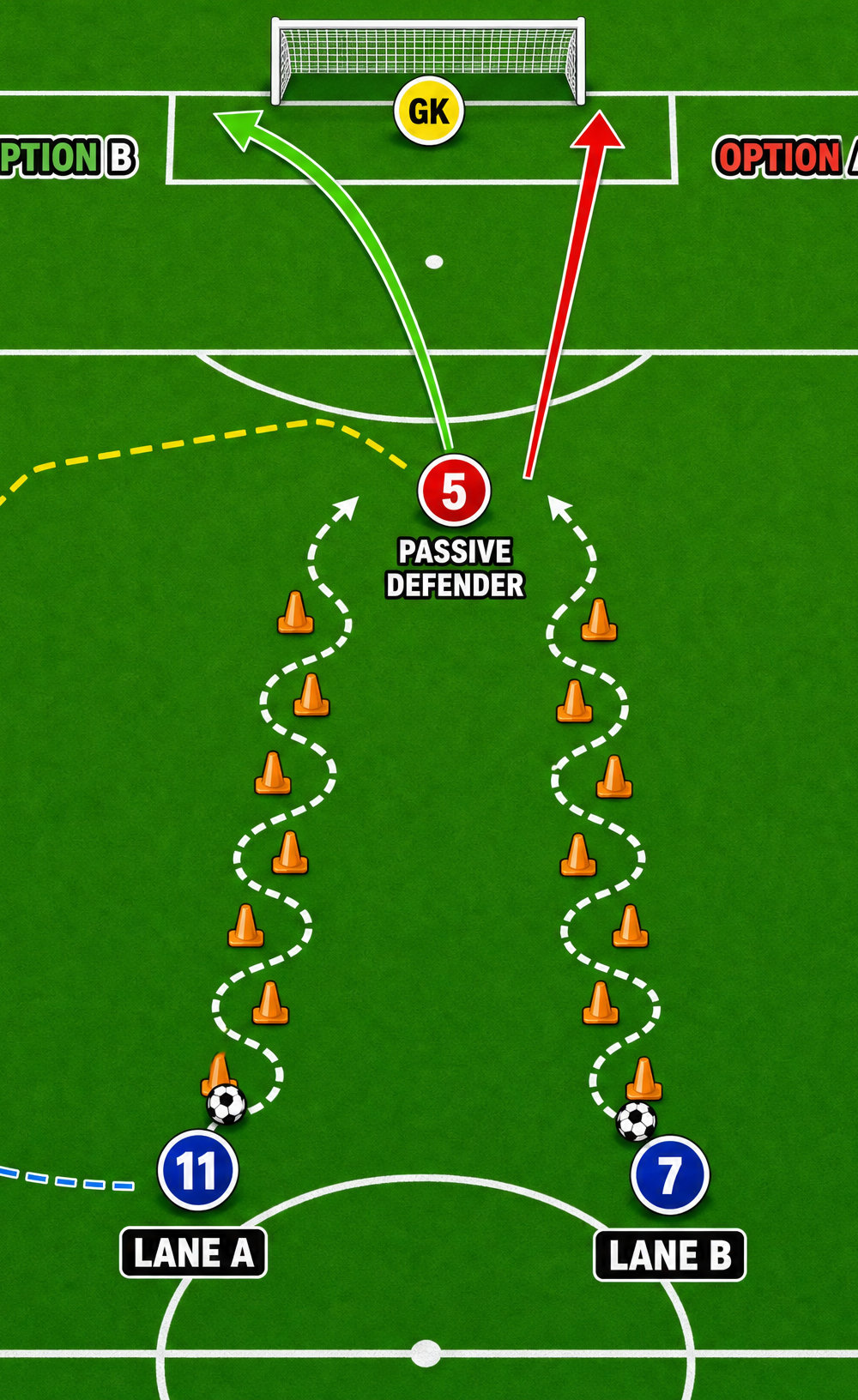
- Progression 2: The Dual-Lane Race: Set up two identical slalom courses side-by-side. Two players race through the cones and finish simultaneously. This introduces competition and pressure, forcing quicker execution.
- Progression 3: Adding a Passive Defender & Support Play: Introduce a passive defender (or a coach) just after the final cone. As the dribbler exits the slalom, the defender steps out slightly. The dribbler must now make a decision: Option A (shoot near post), Option B (cut inside and shoot far post), or Option C (play a lay-off pass to a supporting teammate making a late run).
7. Age Adaptations
- Under 8s - Under 10s: Widen the gap between the cones to 2 metres to allow for easier navigation. Focus heavily on fundamental dribbling technique and simply making contact with the ball for the shot. Praise effort over outcome.
- Under 12s - Under 14s: Keep the 1.5m cone spacing. Demand higher intensity and focus on the quality of the setup touch. Introduce the 'weak foot only' progression early.
- Under 16s - Open Age: Tighten the cones to 1.2m for an extreme test of close control. Demand explosive acceleration out of the slalom and clinical, powerful finishing. Utilize the advanced progressions with defenders and decision-making.