Diamond Shape & Gate Angles: Advanced Support Running Drill
Master offensive continuity by teaching your players how to run sharp, decisive support lines in a dynamic diamond structure to break the defensive line.

Equipment Needed
1. Overview
Support running is the lifeblood of attacking rugby. A line break is only valuable if there are players immediately available to receive the offload or secure the subsequent ruck. The Diamond Shape & Gate Angles Drill is designed to train players to instinctively form a strong support structure around the ball carrier.
This drill emphasizes timing, communication, and the execution of sharp running angles (inside cuts and outside arcs) to exploit gaps in the defensive line. By running this drill, coaches will instill a habit of aggressive, proactive support play rather than reactive, static watching.
2. Setup
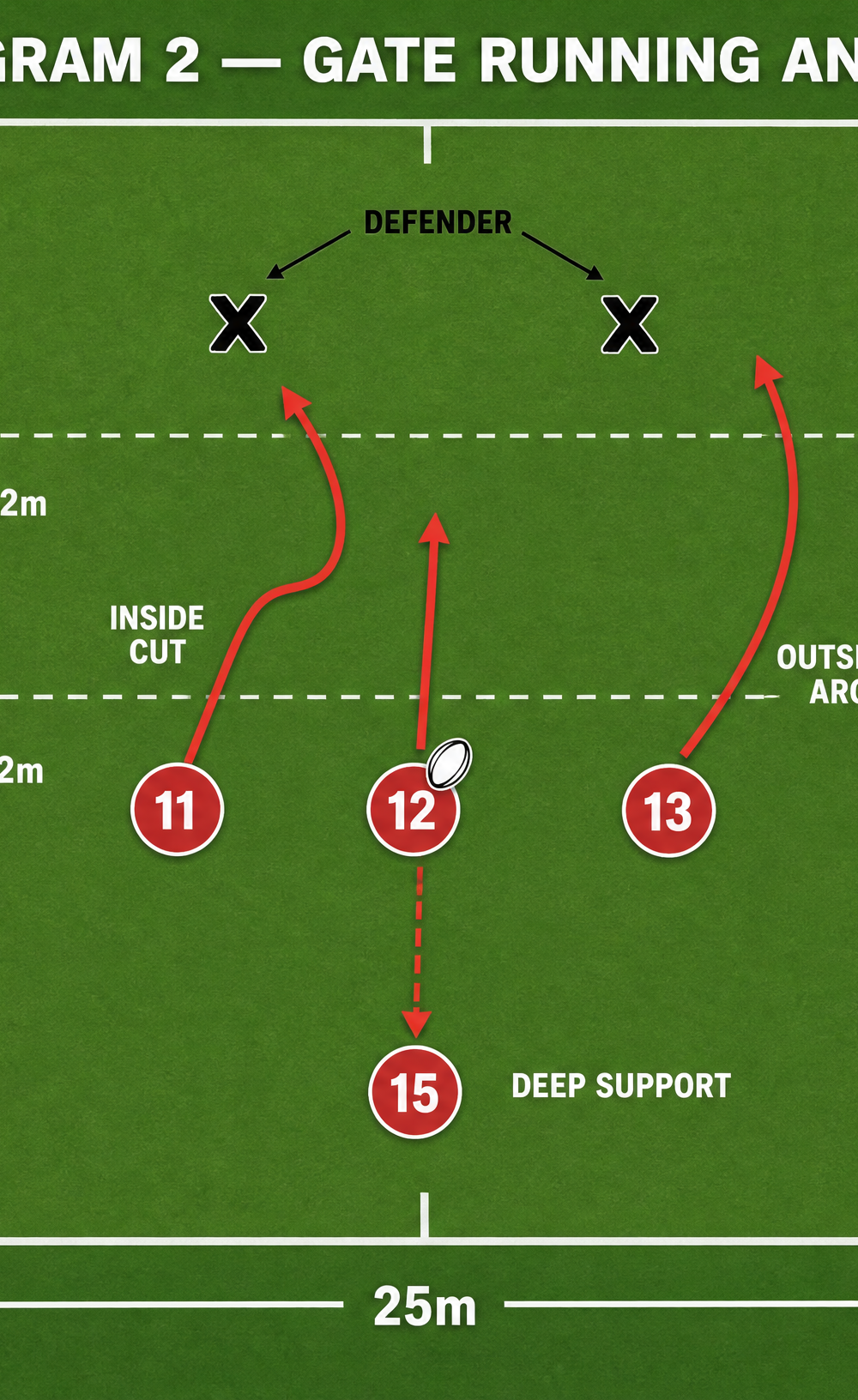
Pitch Area: 40m x 25m grid (adjust based on age group).
Equipment: 10-12 cones, 2-3 rugby balls, bibs (optional, for defenders).
Players: Groups of 4 attackers and 2 defenders.
Positions:
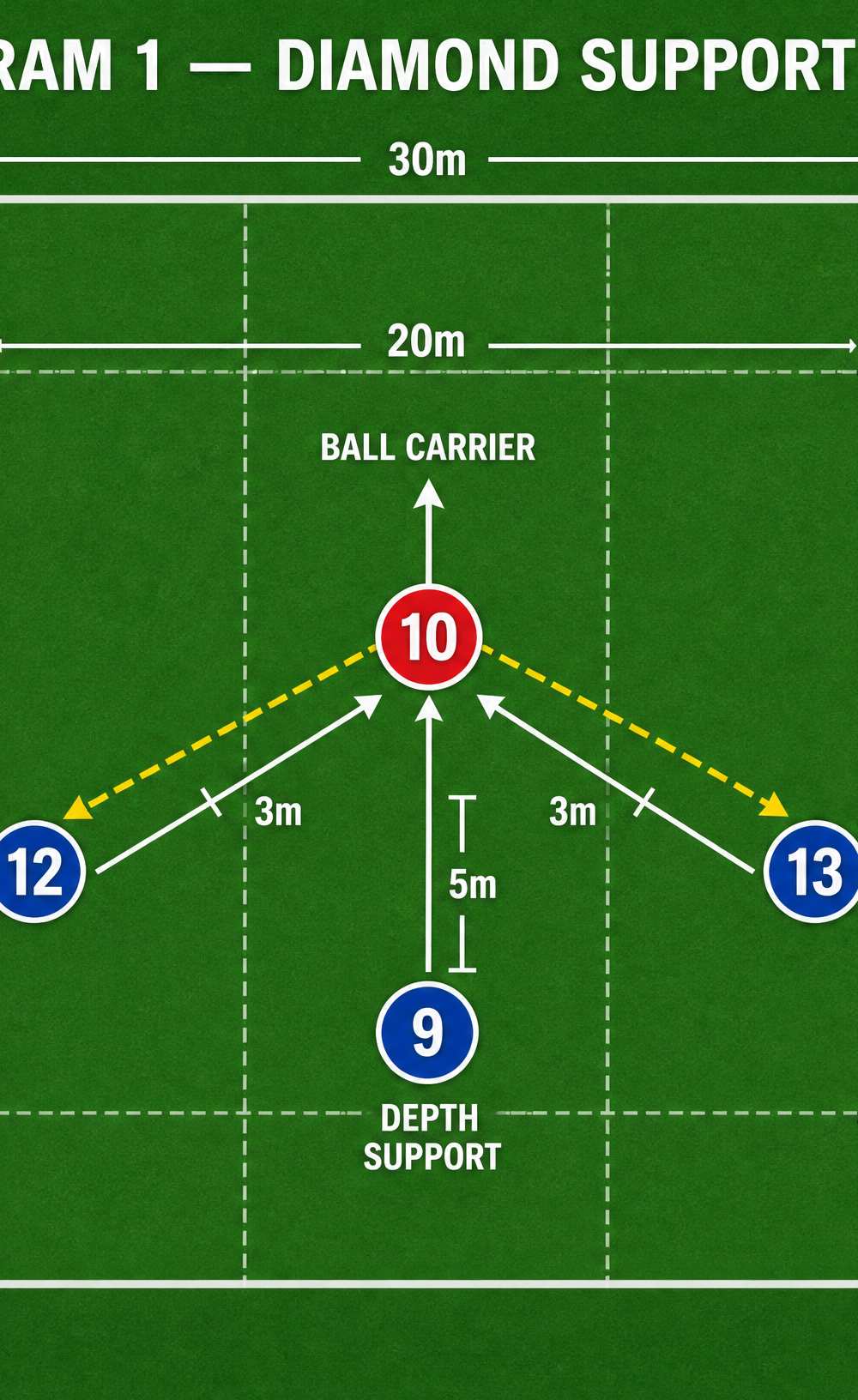
- 10 (Ball Carrier): Starts in the center.
- 12 (Inside Support): Positioned 3m back and to the left at a 45-degree angle.
- 13 (Outside Support): Positioned 3m back and to the right at a 45-degree angle.
- 9 or 15 (Depth Support): Positioned 5m directly behind the ball carrier.

3. Step-by-Step Instructions
- Initial Alignment: Have the attacking pod of four set up in the 'Diamond Support Shape' as shown in Diagram 1. The ball carrier (10) stands flat, while the support runners (12, 13) hold their depth.
- The Go Forward: On the coach's whistle, the ball carrier accelerates forward towards the defensive line (represented by the 2 defenders).
- Reading the Defense: As the ball carrier engages the defenders, the support runners must read the defensive drift.
- Executing the Angles:
- If the defense drifts wide, the inside support (12) must run a sharp inside cut (unders line) to take a short pass.
- If the defense pinches in, the outside support (13) runs a wide arc (overs line) to receive the ball in space.
- The Offload/Pass: The ball carrier executes a pass or offload to the best-positioned support runner just before contact.
- Reset and Repeat: The depth support (9/15) trails the play to either receive a late offload or secure the ruck if a tackle is made. Reset the drill and rotate players.
4. Key Coaching Points
- Hold Your Depth: Support runners must resist the urge to run flat with the ball carrier. Holding depth allows them to accelerate onto the ball and adjust their running angle based on the defender's movement.
- Loud, Early Communication: Support runners must dictate the play. They should be calling for the ball early and telling the ball carrier exactly where they are (e.g., "Inside! Inside!" or "Wide! Wide!").
- Sharp Angles, Not Drifting: The running lines must be decisive. An inside cut should be a sharp change of direction, not a lazy diagonal drift.
- Eyes Up: The ball carrier must keep their head up to read the defense and the support runners, ensuring the pass goes to the player in the best space.
- Accelerate Onto the Ball: The receiver should be hitting top speed exactly as they catch the ball, punching through the defensive gap.
5. Common Mistakes
- Overrunning the Ball Carrier: Support players getting ahead of the ball carrier, taking themselves out of the play and risking a forward pass.
- Silent Running: Lack of communication, forcing the ball carrier to guess where their support is under pressure.
- Static Catching: Catching the ball while standing still or jogging, allowing the defense an easy target. Players must catch the ball at pace.
- Poor Spacing: Players bunching up too close to the ball carrier, allowing a single defender to cover multiple attacking options.
6. Variations & Progressions
- Add Live Defense: Progress from passive 'shield' defenders to full-contact, live defenders to test decision-making under genuine pressure.
- The 'Late Call' Variation: The coach stands behind the attacking pod and calls "Left" or "Right" just before the ball carrier reaches the defensive line, forcing the attackers to react and adjust their angles instantly.
- Multi-Phase Drill: After the initial line break, have the support player who receives the ball immediately go to ground. The remaining players must secure the ruck, and the depth support acts as the scrum-half to launch the next phase.
7. Age Adaptations
- Under 8s / Under 10s: Focus entirely on the basic Diamond Shape. Remove defenders initially and just practice running the shape down the pitch, passing left and right while maintaining formation.
- Under 12s / Under 14s: Introduce the concept of 'Inside' and 'Outside' angles with passive defenders. Emphasize communication and holding depth.
- Under 16s / Open: Full progression with live defense. Focus on the speed of the pass, the sharpness of the running angles, and decision-making under intense pressure.