Wide Overlap Play from Lineout: Creating and Exploiting the Edge
Learn how to effectively stretch the opposition defense and create a decisive wide overlap from a structured lineout, using the fullback to create the extra man.

Equipment Needed
1. Overview
This set play is designed to stretch the opposition's defensive line horizontally across the pitch directly from a structured set-piece. By securing clean lineout ball and executing rapid, accurate passes through the backline, we force the defense to drift. The critical element is the late insertion of the fullback (15) into the attacking line, creating a sudden numerical advantage (an overlap) in the wide channel for the winger (14) to exploit.
Use this play when you have a stable lineout platform, ideally between your own 22m line and the halfway line, and when the opposition's backline defense is showing a tendency to compress or rush up rather than drift effectively.
2. Setup
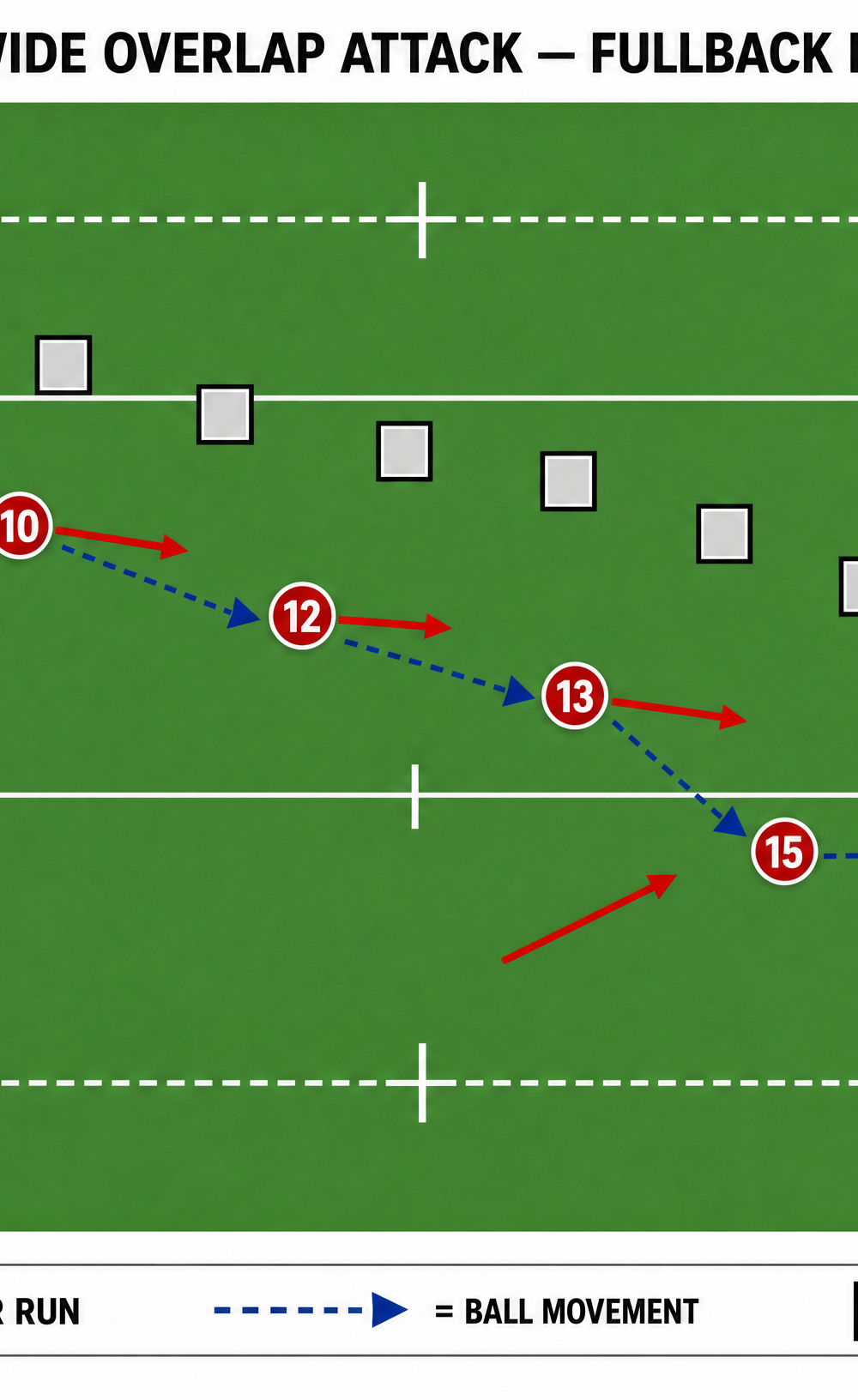
- Pitch Area: Typically initiated from a lineout between the 22m and halfway line.
- Equipment: 1 Rugby ball, 15 players (7 forwards in the lineout, scrum-half, and full backline).
- Player Positioning:
- Forwards: Standard 7-man lineout setup.
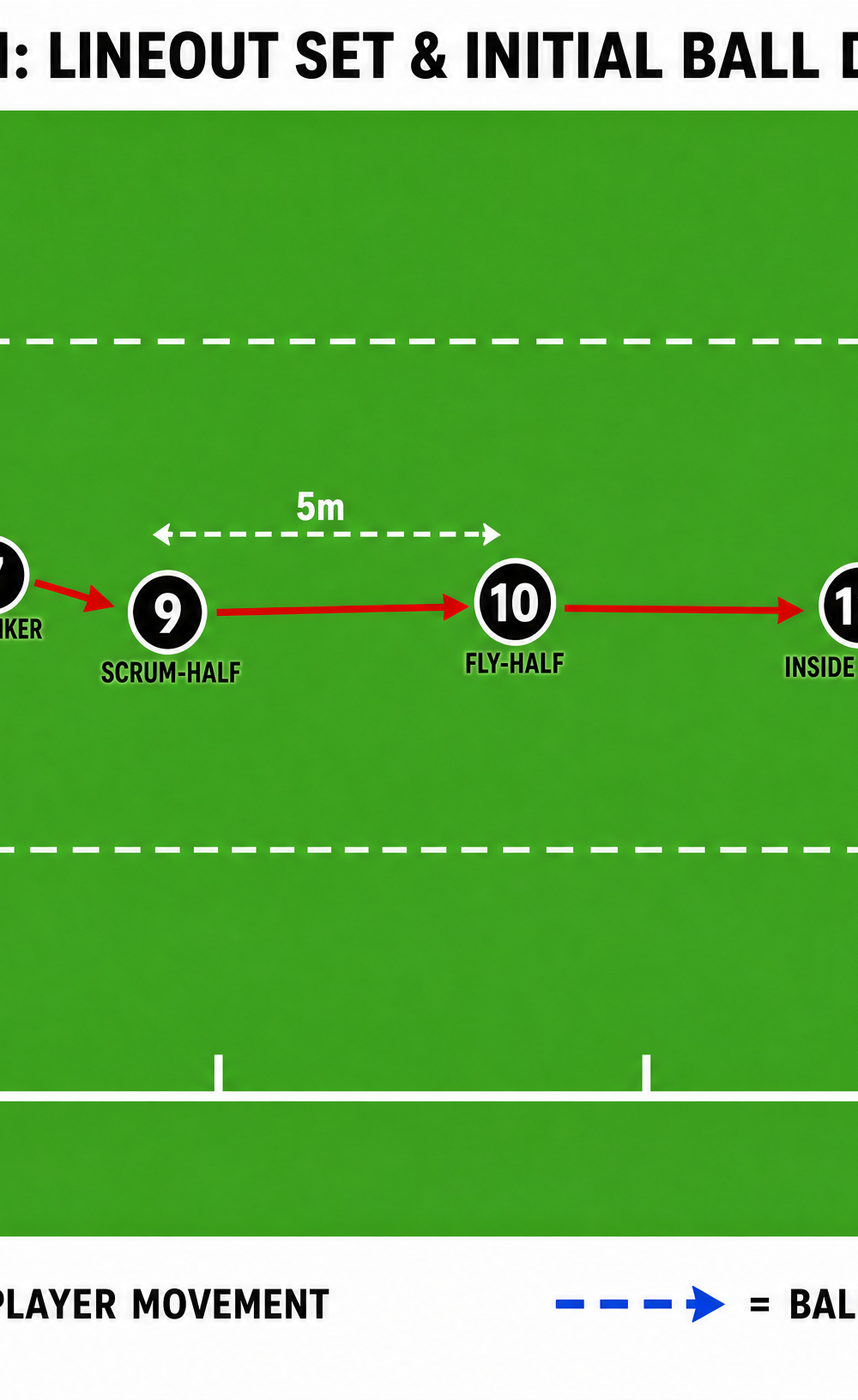
- Scrum-half (9): Positioned to receive the ball from the lineout jumper.
- Fly-half (10): Standing flat, approximately 5 meters from the lineout.
- Centres (12, 13): Aligned outside the 10, ready to run hard, direct lines or pass quickly.
- Wingers (11, 14): Blindside wing (11) prepares to loop as support; openside wing (14) holds width on the touchline.
- Fullback (15): Positioned deep, ready to accelerate into the line between the 13 and 14.

3. Step-by-Step Instructions
- The Set-Piece: The hooker (2) throws the ball accurately to the designated jumper (typically the 4 or 5) in the lineout.
- Delivery: The jumper secures the ball and delivers it quickly off the top to the waiting scrum-half (9).
- The Launch: The 9 fires a rapid, flat pass to the fly-half (10), who takes the ball moving forward to engage the first defender.
- Through the Hands: The 10 passes to the inside centre (12), who immediately transfers it to the outside centre (13). Each player must commit their opposite defender before passing.
- The Insertion: As the ball reaches the 13, the fullback (15) accelerates from deep, hitting the line at pace on the outside shoulder of the 13.
- The Overlap: The 13 passes to the 15. The 15 now has a 2-on-1 situation against the opposition winger.
- The Finish: The 15 draws the final defender and executes a perfectly timed pass to the openside winger (14), who is holding their width on the touchline, to sprint clear in the overlap zone.
- Support: The blindside winger (11) loops around behind the play to provide inside support in case of a breakdown or inside pass.
4. Key Coaching Points
- Speed of Delivery: The success of this play relies entirely on the speed of the ball from the lineout to the 10. Any delay allows the defense to drift.
- Commit the Defender: Every player in the backline (10, 12, 13) must run straight and engage their opposite number before passing. Passing too early allows the defense to slide.
- Timing of the Fullback: The 15 must time their run perfectly. If they arrive too early, the defense can adjust; if too late, the momentum is lost. They must hit the line at full pace.
- Holding Width: The winger (14) must resist the urge to come infield looking for the ball. They must stay on the touchline to maximize the space created by the overlap.
- Catch and Pass: Fundamental catch-and-pass skills must be executed flawlessly under pressure. Hands up, early catch, punch the pass through.
5. Common Mistakes
- Drifting Attack: Backs running sideways instead of straight, which eats up the space they are trying to create for the winger.
- Telegraphing the Play: The 15 lining up too flat or obvious, alerting the defense to the impending overlap.
- Poor Lineout Quality: Slow or messy ball from the lineout gives the defense time to organize and rush up, killing the play before it starts.
- Winger Crowding: The 14 coming too far infield, making it easy for the final defender to cover both the 15 and the 14.
6. Variations & Progressions
- The Dummy Cut: If the defense starts drifting early to cover the overlap, the 13 can throw a dummy pass to the 15 and cut back inside on a hard line.
- Miss Pass: To increase speed to the edge, the 10 or 12 can execute a miss pass (e.g., 10 directly to 13), skipping a player to exploit a narrow defense quickly.
- Kick Pass: If the defensive winger rushes up to shut down the 15, the 15 (or 13) can execute a cross-field kick or grubber into the space behind for the 14 to chase.
7. Age Adaptations
- Under 10s/12s: Focus purely on the catch and pass down the line. Simplify the fullback insertion; perhaps just have the winger start slightly deeper and wider.
- Under 14s/16s: Introduce the timing of the fullback's run and emphasize the importance of committing the defender (fixing the defense).
- Open/Seniors: Focus on the speed of the breakdown, the precision of the dummy lines, and reading the defensive structure to choose the correct variation.