T20 Innings Acceleration Blueprint: From Powerplay to Death Overs
A complete tactical framework for pacing a T20 innings, maximizing powerplay fielding restrictions, rotating strike through the middle overs, and executing high-impact death batting.

Equipment Needed
1. Overview
In modern T20 cricket, innings construction is rarely left to chance. A structured acceleration plan allows the batting side to maximize scoring opportunities across the three distinct phases of an innings: the Powerplay (Overs 1-6), the Middle Overs (Overs 7-15), and the Death Overs (Overs 16-20). This set play resource provides a blueprint for coaches to drill their batters on phase-specific intent, field manipulation, and calculated risk-taking.
The objective is to establish a platform during the field restrictions, consolidate while maintaining a high strike rotation rate through the middle, and launch a calculated assault at the death. By breaking the innings down into these manageable blocks, batters can play with clarity rather than relying purely on instinct.
2. Setup
To effectively run this scenario-based training session, you will need to replicate match conditions as closely as possible.
Equipment Required:
- Full match-spec cricket balls (new for powerplay drills, older for middle/death drills)
- Stumps (both ends)
- Cones or markers to define the 30-yard circle and boundary
- A whiteboard or tactical board for briefing
- Optional: Bowling machine for specific delivery repetition
Pitch and Field Setup:
Set up on a standard 22-yard pitch in the middle of the oval ground. Mark out a clear 30-yard circle using cones. Ensure the boundary is clearly defined. The field placements will change dynamically based on the phase being drilled, requiring active participation from the fielding unit to simulate realistic gaps and pressure.
3. Step-by-Step Instructions
This training session is broken down into three distinct scenarios, mirroring the phases of a T20 innings. Run each scenario as a mini-match simulation.
Phase 1: The Powerplay Exploitation (Overs 1-6)
During this phase, only two fielders are permitted outside the 30-yard circle. The goal is to clear the infield and maximize boundaries without taking reckless risks.
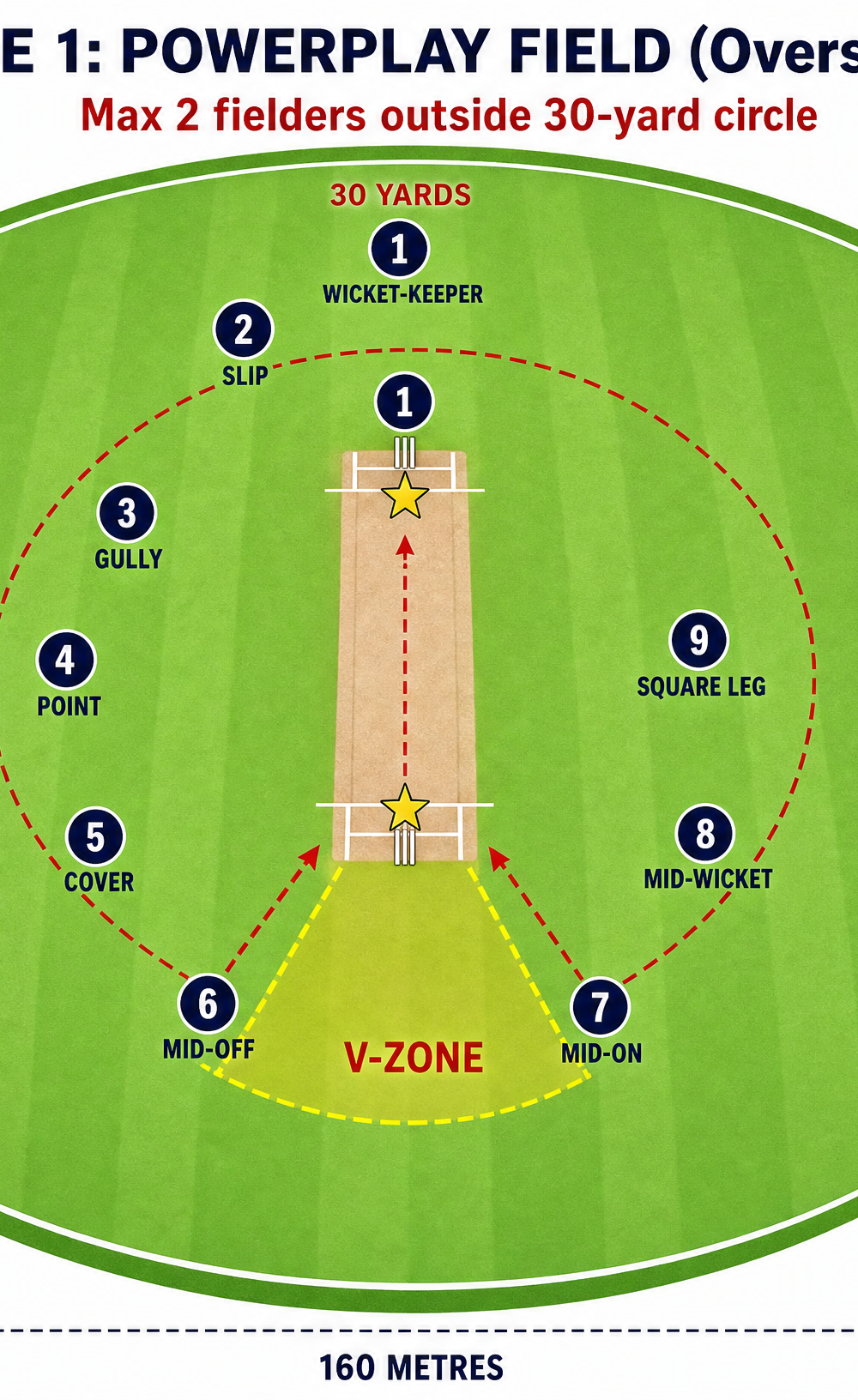
- Set the Field: Place a standard powerplay field. Typical placement: Wicket-keeper, Slip, Point, Cover, Mid-off, Mid-on, Mid-wicket, Square Leg, Fine Leg, Third Man. Only two fielders (e.g., Third Man and Fine Leg, or Deep Square Leg and Long-on) are outside the 30-yard circle.
- The Batting Objective: The opening pair must aim to score at 8+ runs per over. The primary focus should be on hitting over the top of the infield, particularly in the 'V' (between mid-off and mid-on) or square of the wicket depending on the bowler's line.
- Execution: Bowlers should focus on hitting a hard length. Batters must identify the gaps in the inner ring. If mid-off is up, look to loft straight. If point is up, look to cut or drive over the off-side.
- Rotation: Even during boundary-hitting phases, batters must actively look for quick singles to ensure the bowler cannot settle into a rhythm against one batter.
Phase 2: Middle Overs Consolidation (Overs 7-15)
With up to five fielders now allowed outside the 30-yard circle, boundary options decrease. The focus shifts to aggressive strike rotation and targeting specific match-ups.
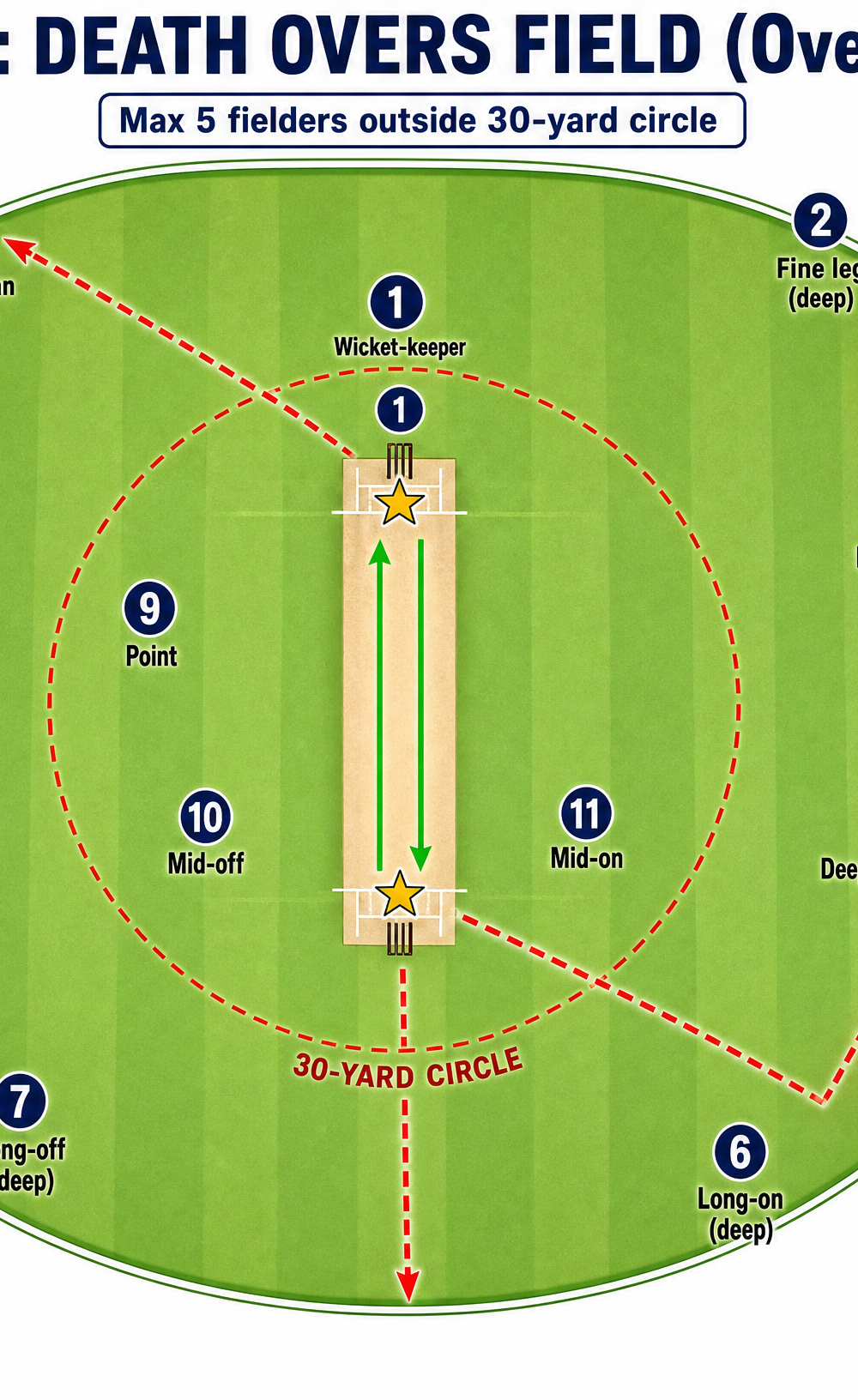
- Set the Field: Push the fielders back. A typical middle-overs spin field might include Long-off, Long-on, Deep Mid-wicket, Deep Square Leg, and Deep Cover on the boundary, with the rest inside the ring saving the single.
- The Batting Objective: Maintain a run rate of 7-9 runs per over with minimal dot balls. The target is to rotate the strike every 2-3 balls and hit at least one boundary per over.
- Execution: Batters must identify the 'sweepers' (deep fielders) and the fielders inside the ring. The key is to hit the ball softly into the gaps for two runs, or use the pace of the ball to guide it past the inner ring for a single.
- Targeting: Identify the weakest bowler or the favorable match-up (e.g., left-hand batter vs left-arm orthodox spinner) and designate one batter to attack, while the other plays the anchor role.
Phase 3: The Death Overs Assault (Overs 16-20)
This is the final push. Wickets in hand are less valuable than maximizing the run rate. The goal is sheer acceleration.
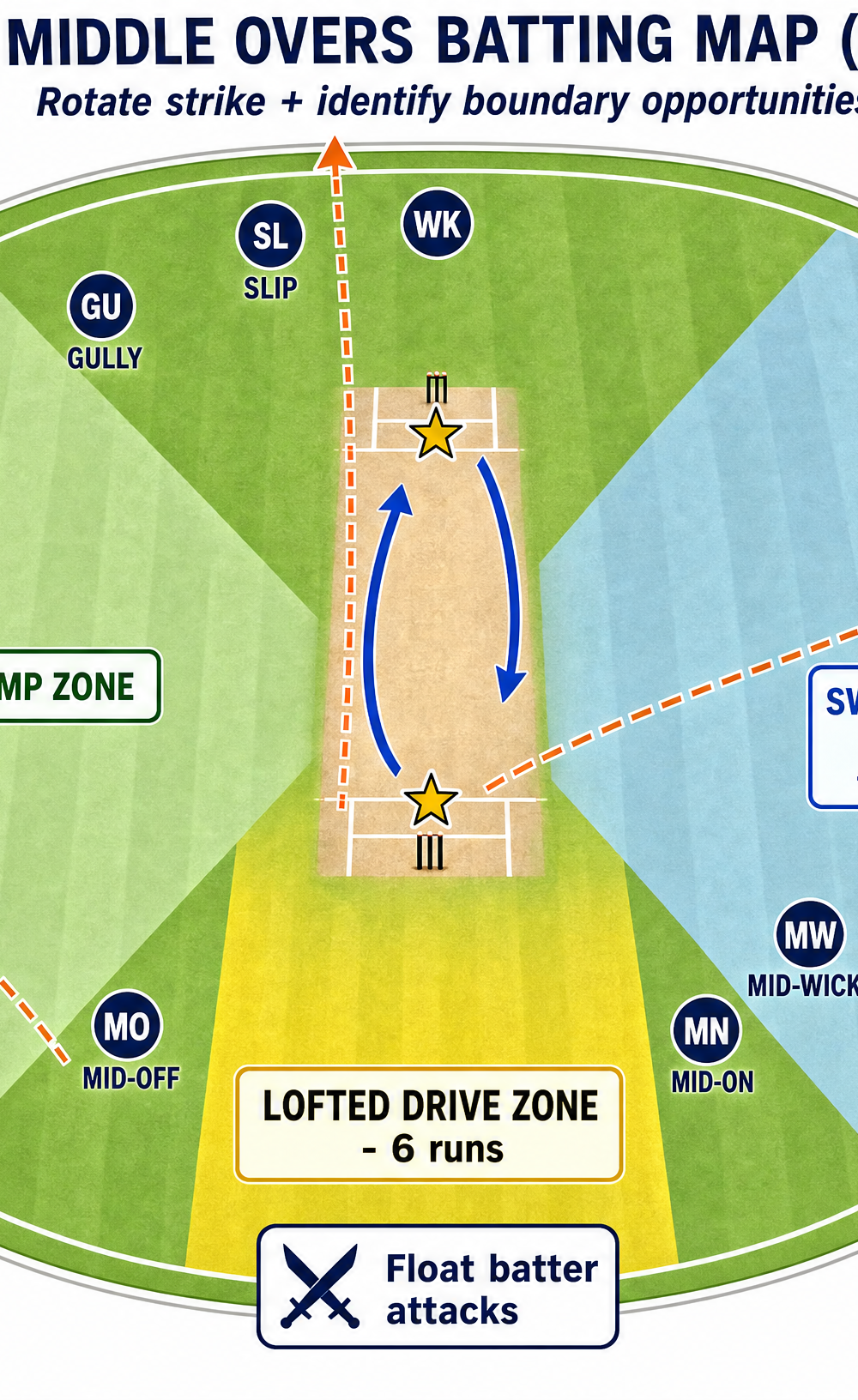
- Set the Field: The fielding captain will likely protect the boundaries. Set a field with five men on the fence (e.g., Long-off, Long-on, Deep Mid-wicket, Deep Square Leg, Deep Cover) and the inner ring protecting the yorker or slower ball.
- The Batting Objective: Aim for 10-12+ runs per over. Every ball is an event. The target is a boundary every three balls.
- Execution: Batters must utilize the depth of the crease to turn yorkers into full tosses or half-volleys. Pre-meditation is often required. Use the crease to access different areas of the field (e.g., moving across the stumps to access the leg-side, or backing away to free the arms over the off-side).
- Innovation: Encourage the use of ramps, scoops, and reverse sweeps to manipulate the field and access unguarded areas behind the wicket.
4. Key Coaching Points
- Intent is Everything: Acceleration doesn't just mean hitting boundaries; it means running hard between the wickets and turning ones into twos. A proactive mindset puts pressure on the fielding side.
- Read the Field: Batters must constantly scan the field before every delivery. Knowing where the fielders are dictates shot selection and risk assessment.
- Match-Up Awareness: Teach batters to identify which bowlers they should target and which they should respect. Not every over needs to go for 15 runs; sometimes 8 runs off a premier bowler is a win.
- Use of the Crease: Particularly in the death overs, standing still makes a batter predictable. Encourage movement deep in the crease or stepping out to disrupt the bowler's length.
- Clear Communication: The non-striker plays a vital role in calling runs loudly and clearly, and advising the striker on field changes they might have missed.
5. Common Mistakes
- Panic Hitting: Trying to hit every ball for six, regardless of length or line, often leads to losing clusters of wickets and stalling the innings.
- Ignoring the Singles: Focusing entirely on boundaries and allowing dot balls to build up pressure. A dot ball in T20 is a small victory for the bowling side.
- Pre-meditating Too Early: Committing to a shot before the bowler has released the ball makes the batter vulnerable to changes in pace or line. The movement should happen late.
- Failing to Adapt: Sticking rigidly to the plan even when the pitch conditions or match situation dictate a change in approach.
6. Variations & Progressions
- Target Scores: Set specific par scores for each phase (e.g., 50/0 off 6 overs, 120/2 off 15 overs) and penalize the batting team for falling short or losing too many wickets.
- Handicap Scenarios: Start the middle overs scenario with the batting team already three wickets down, forcing them to balance consolidation with the need to maintain a healthy run rate.
- Restricted Scoring Zones: During the powerplay drill, award double runs for boundaries hit straight down the ground (in the 'V') to encourage proper cricketing shots rather than wild slogs.
7. Age Adaptations
- Under 12s: Focus primarily on the concept of rotating the strike and running hard between the wickets. Introduce the idea of finding gaps rather than hitting over the top.
- Under 14s/16s: Begin introducing phase-specific tactics. Teach the difference between powerplay fielding restrictions and middle-overs spread fields. Introduce basic target areas for acceleration.
- Open/Seniors: Implement the full scenario as described, incorporating complex match-ups, advanced shot selection (ramps, scoops), and high-pressure death bowling simulations.