Rugby
Set Play
intermediate
under 16
Wide Overlap Play from Lineout: Stretching the Defence
Learn how to execute a precision wide overlap play from a lineout, designed to stretch the opposition defence and create scoring opportunities on the edges.
Jun 10, 20266 min read20 min drill15 players

Equipment Needed
Rugby pitch with clear markings
1 Rugby ball
Cones for marking zones
Bibs for opposition (optional)
1. Overview
The 'Wide Overlap Play from Lineout' is a high-tempo attacking sequence designed to exploit the natural width of a rugby pitch (typically 100m x 70m). By securing clean, quick ball from a structured lineout set-piece, the attacking team rapidly shifts the point of attack to the far touchline. This play is particularly effective when the opposition's backline is defending narrow or when their back-three are out of position. It forces the defence to scramble, creating a numerical advantage (an overlap) on the outside edge, ultimately leading to line breaks or tries in the corner.
2. Setup
- Pitch Area: Typically executed from an attacking lineout between the opposition's 22-metre line and the halfway line.
- Equipment Needed: Standard rugby pitch markings, 1 rugby ball, bibs for opposition (if running opposed in training), cones to mark key alignment zones.
- Player Positions: Full 15-a-side team required. Key roles include the Hooker (No. 2) for the throw, a designated Jumper (e.g., No. 4 or No. 5), the Scrum-half (No. 9) for rapid distribution, and the entire backline (Nos. 10, 12, 13, 11, 14, 15) for execution.
3. Step-by-Step Instructions
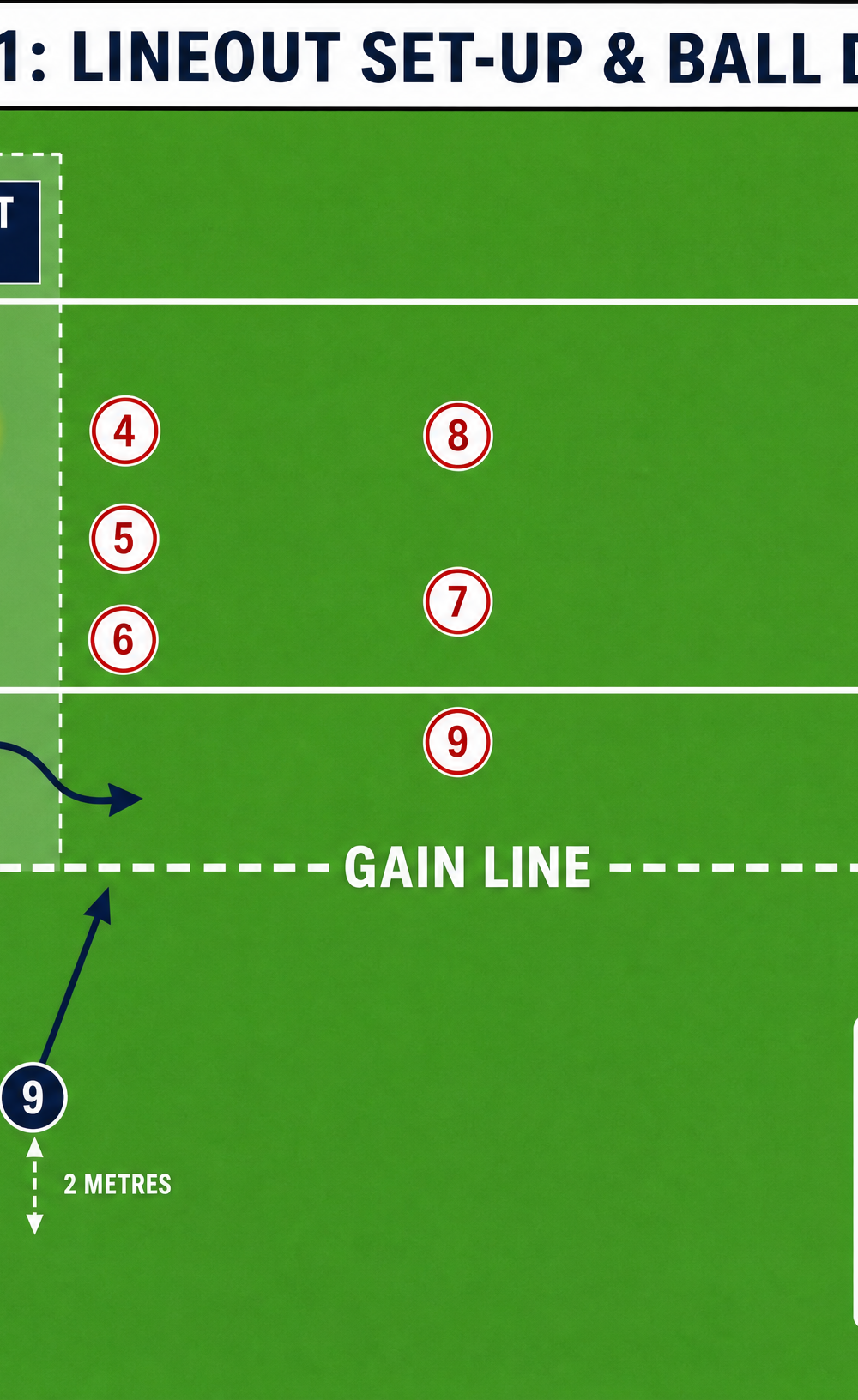
Phase 1: Lineout Set-Up & Ball Delivery

- The Call: The lineout caller dictates a swift, clean jump, typically targeting the middle or back of the lineout to ensure the ball is delivered quickly over the top.
- The Throw: The Hooker (No. 2) delivers a precise, flat throw to the designated Jumper (e.g., No. 4).
- The Delivery: As the Jumper secures the ball, the Scrum-half (No. 9) positions themselves 2 metres behind the lineout, ready to receive the pop pass or immediate delivery from the jumper or the player securing the ball at the back.
- The First Pass: The Scrum-half (No. 9) immediately fires a fast, flat pass to the Fly-half (No. 10), who is positioned relatively flat to engage the defensive line early.
Phase 2: Backline Wide Overlap Execution
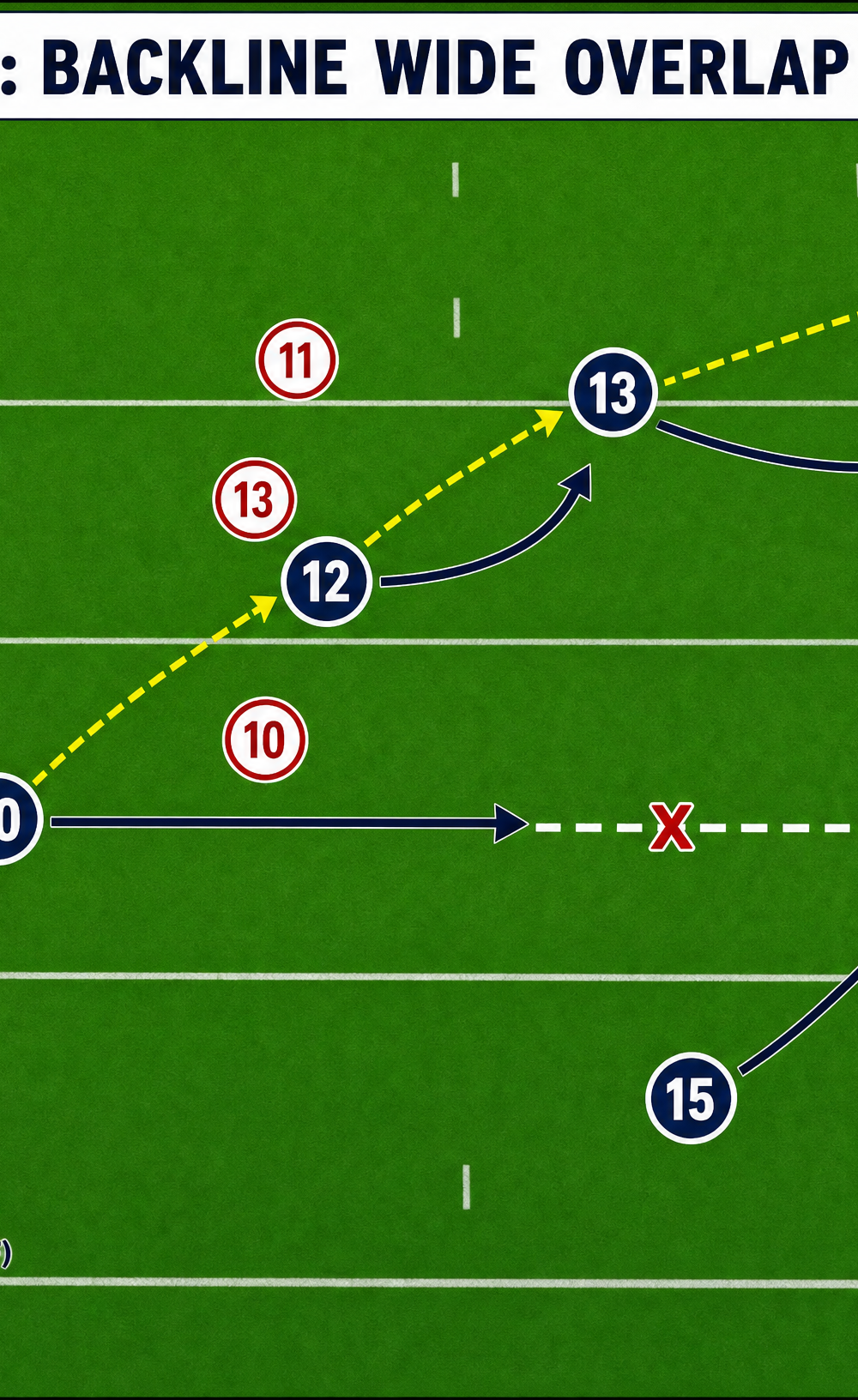
- Engaging the Line: The Fly-half (No. 10) catches the ball while moving forward, attacking the gain line to fix the opposing No. 10 and No. 12.
- Drawing Defenders: The Fly-half passes to the Inside Centre (No. 12). No. 12 runs a slight inside line or a hard, straight line to draw the opposing No. 13 inwards.
- Creating the Width: The Inside Centre (No. 12) passes to the Outside Centre (No. 13), who begins to arc slightly wider, accelerating into the space outside the defensive line.
- The Overlap: The Outside Centre (No. 13) commits the final wide defender (usually the opposing winger) and delivers the crucial pass to the Left Wing (No. 11), who is holding their width near the touchline.
Phase 3: Fullback Support & Finish
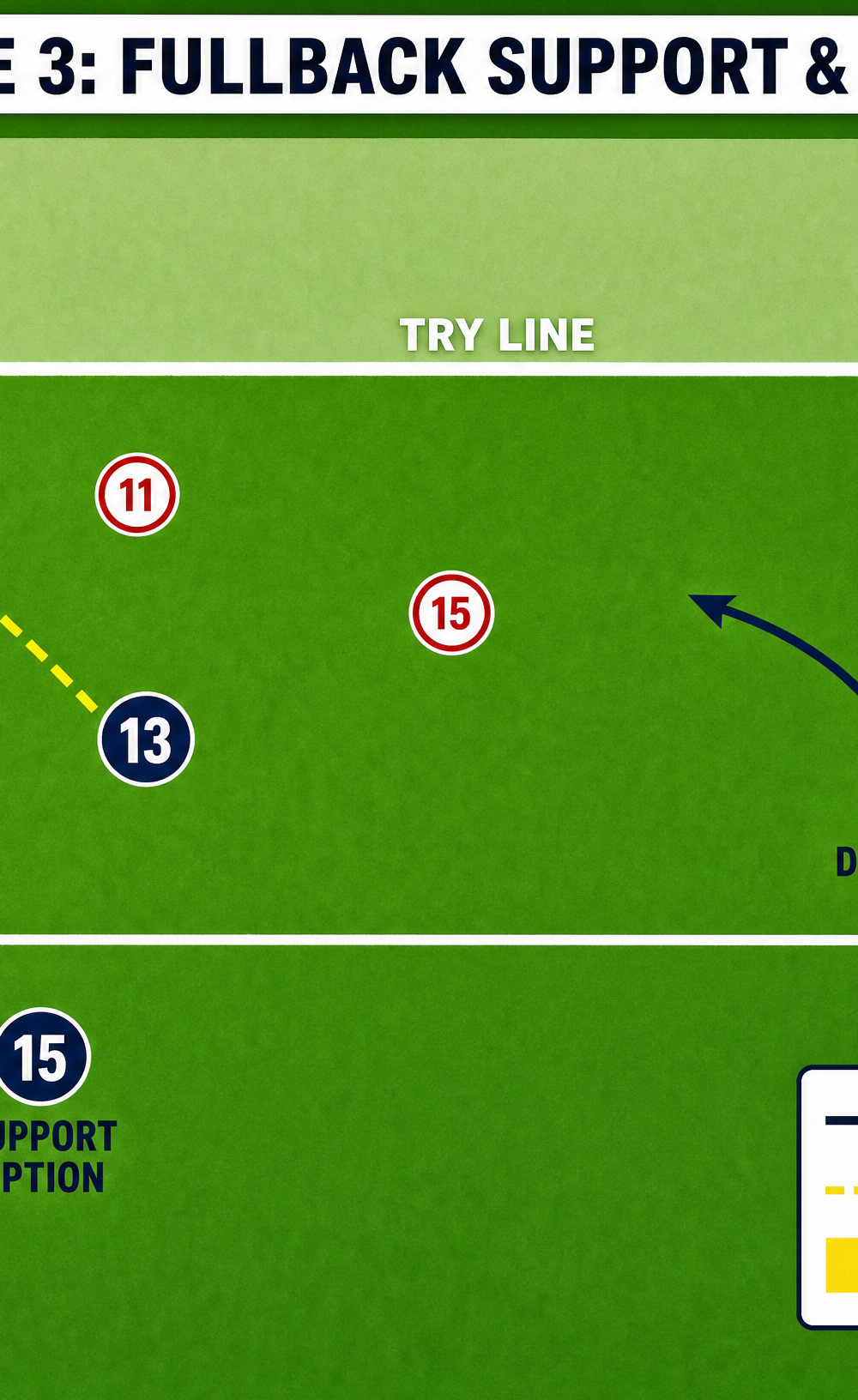
- The Support Line: The Fullback (No. 15) must anticipate the break and run a sweeping support line from deep, positioning themselves on the outside shoulder of the Left Wing (No. 11).
- The Decoy (Optional): The Right Wing (No. 14) can run a hard decoy line back inside to hold the covering defenders.
- The Finish: The Left Wing (No. 11) now has a clear run down the touchline. If the opposing Fullback covers across, No. 11 can either step inside, chip ahead, or utilize the support of No. 15 on the outside to finish the try in the corner.
4. Key Coaching Points
- Speed of Delivery: The entire play hinges on the speed of the ball from the lineout to the Fly-half. Slow ball allows the defence to drift and cover the overlap.
- Fixing Defenders: Every player in the backline (10, 12, 13) must run hard and straight before passing. Drifting sideways pushes the defence across and kills the space on the outside.
- Depth and Alignment: The backline must maintain adequate depth to allow for acceleration onto the ball, ensuring passes are made in front of the receiver.
- Communication: Clear, loud communication is vital, especially from the outside backs (11 and 15) calling for the ball when the overlap is recognized.
- Holding Width: The winger (No. 11) must stay incredibly wide, almost chalk on the boots, to force the final defender to make a decision.
5. Common Mistakes
- Drifting Sideways: Backs catching the ball and running laterally instead of attacking the gain line, which allows the defence to slide easily.
- Passing Behind the Player: Poor passing accuracy that forces receivers to check their run, killing the momentum of the attack.
- Winger Coming Too Narrow: The winger (No. 11) creeping infield looking for the ball, which reduces the space available for the final pass and allows the defender to cover both the centre and the wing.
- Lack of Support: The Fullback (No. 15) reacting too late and failing to provide the crucial outside support option if the winger is tackled.
6. Variations & Progressions
- Progression 1: Introduce Passive Defence: Start with a skeleton defence (just 10, 12, 13) holding tackle shields to force the attacking team to fix their opposite man.
- Progression 2: Full Opposed: Run the play against a full, live defence to test decision-making under pressure and speed of execution.
- Variation 1: The Cut-Out Pass: If the defence blitzes hard on the Inside Centre (No. 12), the Fly-half (No. 10) can throw a long, cut-out pass directly to the Outside Centre (No. 13) or Fullback (No. 15) entering the line.
- Variation 2: Inside Ball: If the defence drifts too quickly to cover the wide threat, the Outside Centre (No. 13) can drop a short pass back inside to the blindside winger (No. 14) running a hard line against the grain.
7. Age Adaptations
- Under 10s/12s: Focus purely on the basic passing mechanics (catching and passing while moving forward) and maintaining width. Simplify the lineout to a basic throw and catch.
- Under 14s/16s: Introduce the concept of fixing defenders and running specific lines (e.g., the hard line by the 12). Add passive defenders to increase the cognitive load.
- Open/Senior: Focus on the minutiae of timing, the speed of the lineout delivery, and reading the defensive system to select the appropriate variation (e.g., cut-out pass vs. through the hands).